Showing posts with label simple 2000. Show all posts

Wednesday, 21 October 2020

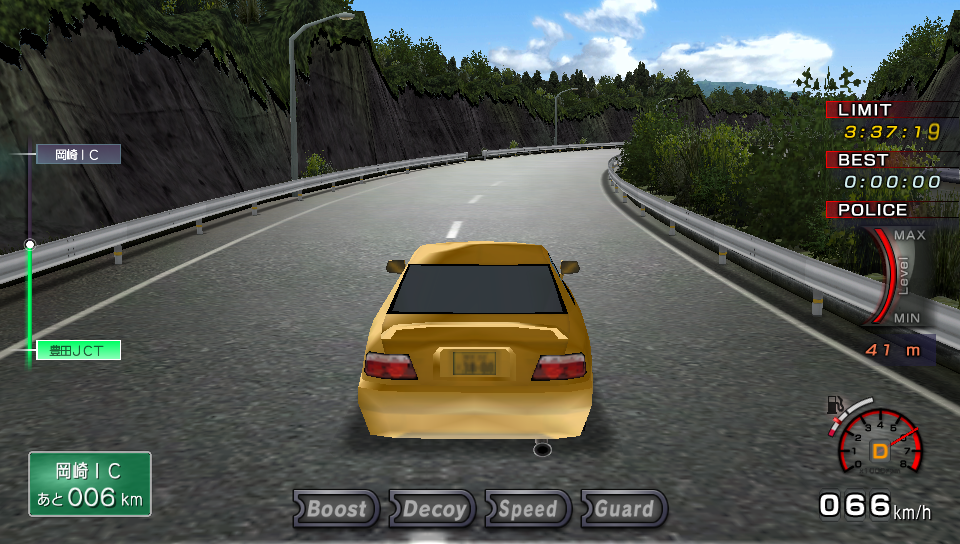
Simple V Series Vol. 2 The Tousou Highway Full Boost - Nagoya-Tokyo Gekisou 4-Jikan (PS Vita)


 That incredibly long title means it's once again time to look at that most beloved of budget game franchises, the Simple Series! It's a bit of a sad entry this one, too, since as far as I can tell, Simple V Series Vol. 2 The Tousou Highway Full Boost - Nagoya-Tokyo Gekisou 4-Jikan is actually the last ever Simple Series game. It's also  a part of the same subseries as a game I've covered in the past, the post-apocalyptic longhaul road trip Simple 2000 Series Vol. 112: The Tousou Highway 2 ~Road Warrior 2050~. Which means that it's also a Tamsoft game! We all love Tamsoft, right?


Anyway, like Road Warrior 2050, it' another longhaul road trip, though this time it's set in present-day Japan, and as far as I can tell you're getting briefcases to deliver them to the yakuza so that they'll release your secretary, who they've lock in a dungeon. While Road Warrior 2050's journey was punctuated by occasionaly sections where you fought waves of enemies on foot, Full Boost breaks up the long drive in a variety of other ways.


The game's main gimmick is that it's not intended for you to complete the whole journey in one car. Most of the vehicle types get damaged very quickly, and all of them have alarmingly small fuel tanks. Obviously, a car with no fuel can't go anywhere, and also if you're in a car when it explodes, that's an instant game over. Furthermore, a car's maximum speed gradually reduces as its fuel meter and structural integrity decrease. So, you get out of the car, and try to steal another one. This is a part of the game that's a little sloppy, though, as the only reliable way of getting a car to stop long enough for you to get into it is to let it run you over. Inexplicably, this doesn't hurt you at all.


Of course, the police aren't going to just let you go on your highway carjacking rampage, and they'll regularly come along to try and spoil your fun. If a police officer catches you on foot, or pulls you out of a stationary vehicle, they'll try and handcuff you, and getting free reduces your stamina a little. Running also reduces your stamina. Despite all this, it seems like the developers wanted to create a non-violent game, as you have no way of keeping the police away, even temporarily. So if there happens to be a few officers around while you're trying to switch to a new vehicle, it can be a little awkward and very difficult to get away with it.


The last thing I want to talk about is the power up system. There are power-ups strewn about the roads here and there, and collecting them progresses a Gradius-style power up chooser along the bottom of the screen, with four different things to choose from. You might be tempted by the quick thrill of selecting Boost every time you pick up an item, but honestly, it's worth saving up four of them each time to get the last option, Guard. What this option does is gives your current vehicle an impenetrable rainbow forcefield, increases your top speed to how it would be if your car was undamaged and full of fuel, and it stops your fuel meter from depleting while it's in effect. Practical and fun!


The Tousou Highway Full Boost isn't some grand swansong for the illustrious Simple Series to bow out on, but it is emblematic of the series at its best: it's a fun, unpretentious game with a lot of low budget b-movie charm. I do recommend giving it a shot, though it's a download-only Japan-only PS Vita game, so its legal accessibility isn't great, and it's only going to get worse as Sony continue their policy of gradually pretending the system never existed. Still, if you can get ahold of it, you should. It's fun.

Saturday, 18 January 2020

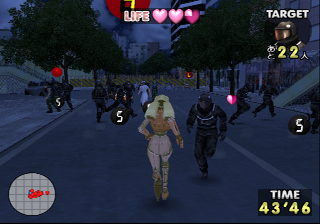
Simple 2000 Series Ultimate Vol. 17 Taisen! Bakudan Poi Poi (PS2)

Some of you might remember the two Poy Poy/Poitter's Poit games on the original Playstation, which had a (very) small cult following in the west at the time. If not, then they were a pair of multiplayer action games, where a bunch of characters in a small field tried to be the last one standing in a game of chucking objects at each other. They had a very distinct visual style, with brightly coloured, very low poly graphics even by the standards of the time. Taisen! Bakuden Poi Poi is at the very least, a spiritual successor to those games. It might be an actual sequel, though because the titles are only similar, not the same, and the fact that I can't find any companies involved in those games and this one.

As well as the Poy Poy games, it's also a kind of modern reimagining of the 1987 arcade game Butasan. While Poy Poy had players throwing rocks and logs and so on to damage each other, Bakudan Poi Poi is all about running around throwing time bombs at each other, just like Butasan. Though Butasan was about cartoonish anthropomorphised pigs in muddy fields, while this game is about realistic humans in a modern day (or at least, early 2000s) Japanese setting. The reaslistic setting actually makes the game feel a lot sillier, as you have schoolgirls, policemen, soldiers, and so on, running around parking lots and suburban wastelands holding big round bombs above their heads and chucking them at each other.

There aren't just normal bombs, either: there's also a rugby ball-shaped bomb that bounces around wildly after being thrown, a landmine, and a UFO-looking bomb that creates a slow movement field when it explodes. There's also a few power-ups. Normal ones, like health refills and invincibility, and stranger ones, like a potion that makes you fall asleep, and an orb that turns you into a bomb, allowing you to lie in wait until another player picks you up before exploding.


Single player mode has you going through a short series of missions as each character. The missions are mostly just to kill a certain quota of opponents before time runs out or you get killed yourself. So it could be "kill 10 policemen", or "kill 30 of any opponent", for example. The final stage for each character is a boss fight against an opponent who has three hit points like you, and can even pick up the healing items like you can.

It's a pretty fun game, all told. It gets repetitive pretty quickly, but the all-round zaniness and the chaos of the constant explosions alleviates that a fair bit. Pretty much perfect for a Simple 2000 game, and it doesn't have any of the pointless grinding that drags down so many of its stablemates, either. If you stumble across a copy at any time, and assuming it still carries an appropriately low price tag, it's definitely worth a try.

Thursday, 15 August 2019

Simple 2960 Tomodachi Series Vol. 3 - The Itsudemo Puzzle - Massugu Soroete Straws (Game Boy Advance)

I'd previously written off the Simple 2960 Tomodachi series, assuming that it was just a bunch of untranslated visual novels like the Dreamcast's Simple 2000 DC series. I happened across some screenshots of this one recently, though, and it turns out I've been wrong all this time, and the GBA Simple games have at least one cute puzzler among them! In fact, looking at the list of titles, I have no idea where I got my previous assumption from, as it's clear that none of them are visual novels at all. But anyway, this is The Itsudemo Puzzle ~Massugu Soroete Straws~, or The Anytime Puzzle ~Line Up the Straws~, and it's pretty good!

The game presents you with groups of stars connected by lines, and you move your cursor thing around, pushing stars up and down the screen so that the connecting lines become one straight line, either horizontal or diagonal. Do it multiple times in quick succession for more points, of course. There's a totally unimportant story about an apprentice witch who I think is trying to hold back the dawn for as long as possible by arranging the stars in the night sky into straight lines? That's what seems to be happening in the main mode, anyway, as the moon scrolls across the screen and the sky gets lighter as time starts to run out, while going in reverse when you get more time while clearing lines.

Other than the main game, there's also a time attack mode, in which you attempt to score as many points as possible in three minutes, and a free mode, which just goes on forever until you quit via the pause menu. Oddly, even the free mode has a high score table, though the nature of the mode means it really just measures the player's tolerance for boredom (though playing free mode did help me figure out little techniques here and there to improve my game, like any good practice mode should).

There's not much more to be said about this game! It's cute, it's fun, and unlike a lot of Simple Series games, a real copy of it can be found for next to nothing online if you're lucky. It's recommended!

Sunday, 12 May 2019

Motorbike King (PS2)

On paper, it almost seems as though Motorbike King (also known as Simple 2000 Ultimate Series Vol. 13: Kyousou! Tansha King ~Kattobi Baribari Densetsu~) was made specifically for me: it's a Bosuzoku-themed racing game, in which you can choose to play as a sukeban, and not only is it a Simple Series game, but it was even developed by those B-grade legends at Tamsoft! It was a disappointment, then, to actually play it and find an awkward game with motorbikes that handled like shopping trolleys and an absolutely merciless difficulty curve.

Luckily, I stuck with it for a couple of hours, bolstered by my love for the aesthetic the game was presenting, and once you've got a grip on the weird handling and you start winning races, it becomes a lot more satisfying. The main problem is, as already mentioned, the brutal difficulty curve: the fact is that even if you have a decent lead on your opponent, if you mess up once, that's all they need to not only overtake you, but to zoom off into the distance, never to be seen again. Once you get a couple of upgrades for your bike, you might be able to regain the lead, but only if you lost it early in the race, and you drive perfectly from that point on.

Anyway, as you might have gathered, the game takes place over a series of one-on-one races, all on public roads, and all at night. As far as I can tell, there are three underling opponents you have to beat, before you can face off against the two bosses. There might be further races beyond those two bosses, but I haven't managed to beat either of them yet, so I can't currently confirm that. During the races, you'll get told at certain points in each lap (they're the same every time, so you can be ready for them after your first time round) "Appeal Time Remaining", an awkwardly translated prompt for you to partake in a bit of showing off. There's various tricks you can do by holding down R2 in combination with other buttons, such as standing up and dancing atop your bike, pulling a wheelie, or playing the start of Auld Lang Syne on your horn. While playing, though, I've learned that the best trick to do, in terms of risk taken, ease of input, and points gained, is simply taking your hands off the handlebars and waving them around, by holding R2 and L1 together.

At the end of each race, the points you get from performing stunts (AP) get converted into the points you can spend on bike upgrades and cosmetic items (KP). Win the race, and you'll get a couple of hundred KP, plus another one for every 200 AP you earned during the race. Lose, and you'll get ten KP, plus one for every 2000 AP you earned. So you can unlock stuff without winning races, but it's significantly more laborious. A nice little touch you'll notice while navigating the game's menus is how colloquial they are: rather than every confirmation prompt offering Yes and No, each one is different, and they're all a lot more casual than that.

In fact, the translation and localisation of this game is really interesting generally. It's a game themed around a very specific Japanese subculture, and yet there's been almost no effort to try and shoehorn it into looking or feeling like some kind of western equivalent. I assume this was done to avoid the additional costs and time involved in that kind of aggressive localisation, but remember that only a few years before this, we had the Playstation port of Gunbird being stripped of all its personality and localised as "Mobile Light Force". So whatever their reasons for doing it were, some thanks should go to 505 Games for leaving this one intact.

I've actually had a few people asking me on social media sites to recommend Simple Series games for them to play, so I'll probably be covering a few more in the near future, too. In this case, I'll say that if you like the aesthetic and setting, and you have the patience to get through the steep learning curve, Motorbike King is one that's worth seeking out.

Friday, 12 April 2019

Simple DS Series Vol. 31: The Chou Dangan!! Custom Sensha

As you look at the screenshots of this game, with the knowledge that it's a platform shooter about driving tanks, it would be easy to just write it off as a cheap Metal Slug knock off. It is a cheap Metal Slug knock off, but importantly, that's not all it is: it does have enough of its own qualities to justify its own existence. It's another nice little sample from the Simple DS Series, after all.

Being a Simple Series game, it does adhere to their usual design philosophy: upgradable characters, selecting the next stage you want to pay from a menu, lots of difficulty levels, and so on. It does take a few detours from the usual route, though: grinding for experience points only increases the max HP of your tank, as weapon and mobility upgrades are hidden throughout the stages as items. Furthermore, while most Simple Series games will pad themselves out with grinding and recycled stages and enemies, The Chou Dangan Custom Sensha is short and sweet, being only about an hour long from start to finish, with the aforementioned grinding never really being necessary. Completing story mode unlocks a score attack mode, which is mostly the same, to the point where I can't actually figue out what the difference is meant to be.

What's most interesting about this game, though, is that depite the fact that (as far as I know) tanks can't jump in real life, this is a platform game about driving a tank where the limitations and abilities of a tank are taken into account. For example, you have two guns: one that can be swivelled around in almost a full circle, and you main turret, that can't be aimed, raised, or lowered. So you  really have to take into account your height relative to the enemies when you're shooting them. Another thing relates to the tank treads: if you jump up to a higher platform, and only just about get onto the edge of it, you can keep pushing forward to kind of climb onto it using the movement of the tank treads. It's only a little thing, but it's very satisfying.

If you can find a copy for cheap, then The Chou Dangan Custom Sensha is definitely worth picking up. The only real downside it has is that it's very short, very easy, and not really exciting or interesting enough to play through more than once. But that one playthrough you have will be a fun time, at least.

Thursday, 6 September 2018

Simple 2000 Series Vol. 73 = The Saiyuutou Saruden (PS2)

This game has a lot in common with the early Oneechanbara games: it's by Tamsoft, it's a low budget musou game, and it has a lot of wandering around big, multi-map stages like a lost idiot. But! There isn't just the "Journey to the West" theme to differentiate it, as it does actually bring a few ideas to the table, even if they're more interesting in theory than they are fun to engage with in practice.

The premise is one that just seems so obvious for a 3D game based on Journey to the West: you play as Monkey (and later Pigsy and Sandy too), and your job is to escort Tripitaka (note: I'm using the names from the UK dub of the 1970s Japanese live action Saiyuki TV show, just for convenience) across big stages filled with various kinds of demons. There's a few complications that took me a while to figure out at first, though.

Firstly, you've got to find the place to which you're escorting Tripitaka. You go out, find the thing, then go back and tell her, and she'll start moving. There's a huge statue you've got to find and take her to to pray to, and a smaller statue, the finding of which will encourage Tripitaka to take you to the sealed gate to the stage's boss, that you have to fight. The first two bosses are Pigsy and Sandy, and Sandy is the point at which I gave up on the game, after spending over 30 minutes repeatedly being killed by him. Sorry, but he takes off a third of your health right at the start with an unavoidable combo, and then interrupts all your attempts to fight him with the same. It's no fun, and it totally killed my interest in the game.

But other than that, the whole reconnaisance/escort aspect of the game does a lot to differentiate it from other musou games, though I feel it might have been better if they'd have waited a few years and put it on more powerful hardware. The problem is that the stages have to be pretty big by the nature of the game, which means they have to be split up into a few smaller maps, with loading times between each of them. Since you're definitely going to be back and forth, that means you're subjected to numerous loading screens no matter what. There's also the problem that when you leave an area and come back, all the enemies will have respawned, though you can lighten that burden by just running past them all the first time through.

Obviously, though I spent a few hours playing The Saiyuutou Saruden and it does have some potential, I can't really recommend it. It's a shame its ideas never got re-explored on hardware more capable of fulfilling them. Also, it's totally ruined by the unfair, unfun bosses (even though I did beat the first one, it was still an awful experience, and mainly down to luck).

Wednesday, 6 June 2018

Simple 1500 Series Vol. 30: The 1 on 1 Basketball (Playstation)

When you look at a list of arcade games, there's one name near the top that always sticks out, to me at least: 1 on 1 Government. I always notice it, because it's close to the top of an alphabetically ordered list, and it's such a strange title that gives nothing away about what kind of game it is. What it is, though, is a port to arcades of this, more sensibly titled Playstation game.

It's surprising that it was a Playstation game before it was an arcade game, as it's structured very much like an arcade game, and, like Lethal Crash Race tried to apply the Street Fighter II formula to racing games, The 1 on 1 Basketball tries to do that for Basketball. You pick a character from a pretty big selection (that includes, aong a few regular people, a monkey, an angel, and some kind of childish cartoon drawing of a person), and you go on to face the other characters in a series of basketball games. By default, the games last ninety seconds, or until someone scores eleven points. Also, I don't know if this is an actual basketball rule, but if the time ends on a draw, the game carries on for another twenty seconds. This didn't strike me as odd, but it'll keep doing that until there's a winner, one way or another.

It should be mentioned that as well a the 1 on 1 mode, there's also a 2 on 2 mode, though as far as I can tell, there's no "canon" teams, so you just throw any two characters together, and your CPU opponents will do the same, and it otherwise plays out the same as the main mode, except the stages are a little too small for it, so there's a lot of bumping into each other. Anyway, this game plays pretty well! The controls are simple enough to pick up: you move left or right across the court, with up and down moving you left or right in relation to your oppnent's position. There's also a button each for shooting, getting in your opponent's way, and trying to steal the ball. Like the fighting games it's trying to emulate structurally, it's fast paced, and easy to start playing straight away.

Anyway, yeah, I recommend playing this (or the arcade version, since as far as I can tell, there aren't really any differences between them). For various reasons, I keep getting more curious about arcade sports games these days, and it seems like a lot of them are pretty good (this one being no exception).

Tuesday, 12 December 2017

Simple 2000 Series Vol. 60: The Tokusatsu Henshin Hero

Like the last PS2 game I covered, Seigi no Mikata, The Tokusatsu Henshin Hero is a game that's heavily themed around the genre of Japanese superhero TV shows (though you could probably guess that from the title). Being a Simple 2000 game, however, it eschews the strange meta "living in a tv show world" approach of Seigi no Mikata, and takes the more obvious path of being a beat em up in which you fight a bunch of goons before a monstruous boss.

The tokusatsu flavour is still pretty strong, though. Even though the plot is all in Japanese, it's still easy enough to follow and all the classic cliches of the genre are there: the scientist who gave you your powers watches over you, there's generic footsoldier enemies, along with cheesy-looking monsters, and above the monsters, there's occasional fights against higher-ranking, re-occuring enemies, too. In fact, one of those re-ooccuring enemies, named Yabaider is a direct homage to the character Hakaider, who first appeared as a villain in the 1972 TV series Android Kikaider, and even had his own spinoff movie in 1995 entitled Mechanical Violator Hakaider. Interestingly, as it is a budget game, it takes something of a tokusatsu-style approach to cutting costs, too: the same few locations are reused over and over, there's a lot of padding out by having you fight off increasingly large groups of identical footsoldiers, and none of the battles are particularly grand or spectacular.

These cost-cutting measures unfortunately result in a game that is incredibly repetitive, though. Every stage plays the same, and the first half in which you fight the generic enemies gets longer and more labourious each time as they come in bigger numbers and with more HP each time. The bosses also have far too much HP, as once you've learned their patterns, you're left avoiding them and very gradually chipping away at their life bars for several minutes. Of course, maybe if I could read the unlock conditions for more weapons and moves, maybe it would all have been a lot more fast paced, so the Japanese-literate among you might have a better time (though obviously, I can't promise anything. maybe all the unlockables are rubbish).

You can pick a male or female base, and can choose various costume parts, with more being unlocked as you play, along with more attacks and weapons. At first, I thought there was an Earth Defence Force type situation going on, whereby items are unlocked at random when you finish a stage, but on closer inspection, it appears that each item has a specific unlock condition to be met. This is actually the one place where the language barrier was a problem, as the unlocks started to dry up a few stages in, and I couldn't figure out how to force more of them. It's only a small problem though, as early on, I unlocked a laser pistol and a kind of jumping splits kick, which are both incredibly effective at taking down both footsoldiers and bosses alike.

On the subject of the language barrier, it should also be noted that there are rumours of a European release of this game, from 505 Gamestreet, under the title "Power Fighters". However, though it's appeared on various release lists and so on, I've never seen a copy for sale online or off, nor have I seen any screenshots or footage, and no disc image has ever been ripped and uploaded to the internet as far as I'm aware, either. So I suspect that Power Fighters either doesn't exist at all, or if it does, only on some long-forgotten hard drive in Italy somewhere. Of course, if I'm wrong and it did actually get released, and you can prove it, please let me know.

In summary, The Tokusatsu Henshin Hero is almost an archetypal Simple Series game: it's cheap and repetitive, but also very charming and obviously made with love. It's best played in short bursts of one or two stages at a time, it would definitely be agonising to endure for longer sessions.

Sunday, 3 September 2017

Simple 2000 Series Vol. 112: The Tousou Highway 2 ~Road Warrior 2050~

You have to admit, just looking at the title, that this game has a lot of potential right from the start. Of course, it's a Simple Series title and it's yet another game on this blog by Tamsoft, so I still approached with some caution, knowing that the higher I raised my hopes for a cool Mad Max knockoff game, the more likely they'd be dashed, and the game would turn out to be some awful fiddly rubbish.

Luckily, my fears were unfounded, and though the game's low budget did result in some minor problems, like all the stages looking the same, The Tousou Highway 2 is easily one of the best the Simple 2000 Series has to offer. The premise, as far as I can tell, is that in the post-apocalyptic future, your wife/sister/friend/some random woman is dying in Nagoya, and you have to drive your precious cargo of medicine to her from Tokyo in under four hours. Obviously, between the two cities there are an endless amount of goons riding motorbikes and armoured cars who want to stop you, though I have no idea way.So you drive across a number of stages, shooting enemies as you go, and that four hour time limit is in real time, though it doesn't count time you spend in the pause menu or the shop/pitstop screen.

 A few months ago, I played through the 2015 Mad Max game on PS4, and while most of the game was a fairly standard (though very pretty) map-tidying open world dealy, the vehicular combat was probably the best I've ever seen, especially during the convoy chases. Tousou Highway 2, being a low-budget game from nearly a decade before Mad Max came out, obviously can't match up to the newer game in terms of sophistication, but the thing is, after I'd finished Mad Max, I said "I wish there was a game that was just the convoy battles from this", and Tousou Highway 2 is pretty close to that!

It's a very very simple version of that, but still: you get to hurtle down the highway in a cool-looking post-apocalyptic car, constantly killing bandits, either by gunfire or just by smashing through them with your car, and it all takes place in the crumbling ruins of the twenty-first century. It feels fast, killing bad guys is fun and satisfying and it's just great all-round. Well, that part of the game is,at least. Once every stage or so, you'll have to stop your car and get out, because the bad guys have built a barricade. You go in the barricade and fight a whole bunch of goons on foot, sometimes accompanied by a heavily-armed boss. Once they're all dead, the barricade explodes and you can get back in you car and be on your merry way. It's not exactly terrible, but it does break the flow a little bit.

The only other problem I have with the game is that it's incredibly easy. You hardly take any damage (which is represented by an image of the vial of medicine gradually cracking), and when you do, there are more healing items around for you to stockpile than you'll ever need. Furthermore, the time limit is no challenge, either, as on my first attempt I finished the game with over an hour and a half left over. But even taking those few small qualms into account, I definitely recommend seeking this game out and giving it a go. It's excellent.

Tuesday, 15 August 2017

Space War Attack (PS2)

When I first started playing Space War Attack (also known as Simple 2000 Series Vol. 78: The Uchuu Taisensou), I had planned to liken it to a videogame version of an Asylum movie. But as I played it more, I realised how unfair that was: as much as I love The Asylum, the name conjures, in most people's minds, an image of incompetence and lack of imagination. Now I'd say that's unfair as a start, since The Asylum have made plenty of legitimately enjoyable movies and TV shows and it'd take a tedious snob to deny that. Actually, Space War Attack IS like an Asylum film in videogame form: it takes a simple concept and a low budget, and combines them with a shameless kind of creative enthusiasm to create something that's a ton of fun.

Anyway, it's a 3D action-oriented combat flight sim-type thing, in which you fly around, firing locked-on missiles at enemies and so on. The hook, though, is the enemies themselves: while most stages will have a squadron of enemy fighters getting in the way, which look a lot like organic fighter jets (kind of like the ones in Space Harrier II), your main target enemies are a bit more exciting. There's bigger fighter/bomber aliens, which look kind of like the Toho kaiju Battra, there's giant scorpions and snakes, meteors, enormous flying mechanical starfish, and so on. A lazier person would sum it up as being "Earth Defence Force in a fighter jet!", but though there's a lot of undeniable similarities, the atmosphere and feel is totally different, in some vague, hard to describe way.

I think special note should also be made of the settings for the stages. Though it does partake in the traditional Simple Series cost-saving trick of reusing maps at different times of the day, those few maps are really great-looking. In the stages I've played so far, I've seen, among others, a city in the middle of the desert, a series of super-futuristic solar/hydro power plant facilities in the ocean, and a bigger city that's built on a concentric series of artificial islands surrounding a huge volcano emerging from the sea. It's all very futuristic, and more importantly, with its gleaming cities, blue skies and apparent commitment to renewable energy, it is as the Overwatch slogan goes, a future worth saving.

In my review of Savage Skies, I compained that a common problem I've had playing this genre is that you often end up chasing a little arrow pointing to the nearest enemy off the edge of the screen. I don't know how the developers did it, but that's not something I've had much of a problem with in Space War Attack, and it's even better when you unlock long-range lock-on missiles a few stages in. It seems that the developers Bit-Town are responsible for a few other PS2 flight sims, and I may well seek them out at some point in the future, so high is this game's quality.

Space War Attack is a great game: a cool setting, and a ton of fun to play. The downside is that it's a good game from the Simple 2000 series that got a PAL release, which means that copies are hard to get hold of, and as such, there's currently none of them on Amazon, and the cheapest on Ebay is about £50. You might have better luck looking for the Japanese version, though.