Showing posts with label 3DO. Show all posts

Tuesday, 15 March 2022

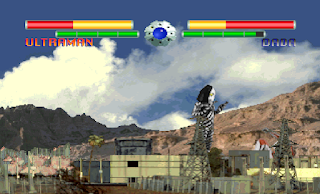
Ultraman Powered (3DO)


 Sometimes, you encounter a game that's centred around a concept so obvious, you can't believe you've never encountered it elsewhere. Ultraman Powered (based on the Japan-US co-produced TV show that's also known as Ultraman: The Ultimate Hero) is a game that has two such concepts! And it's hidden away on a console nobody cares about!


The two concepts are kind of related, though, being both related to the fact that this is a fighting game that makes use of digitised sprites. Firstly, it's the first game I've seen that mixes them with live action FMV cutscenes, but the real shocker is that this is the only game I can think of that's based on a tokusatsu TV show or movie that uses digitised sprites! It's such a natural combination! Not to mention the glory days of the Mortal Kombat series coincided with the heyday of Power Rangers, VR Troopers, and all the other American "localised" versions of toku series.


So, is it any good? Eh, not particularly. To be more fair, it is fun to play, and there are positive aspects to it, like how the digitised look really does fit perfectly with the theme, but there's some real problems, too. In single player mode, you play as Ultraman, and you fight against various kaiju one after another, like you'd expect. You've got a couple of special moves that aren't particularly impressive or useful, and the controls are laid out very strangely: you've got light and heavy punches and kicks. The punches are assigned to the A and B buttons, while the kicks are assigned to C and the right shoulder button. This isn't an arcade port or anything, it's a 3DO exclusive! Why didn't they design the controls more logically based on the controller that they knew players would be using?


There's actually two modes for single players: visual and battle. The only differences between them are that visual mode has fairly long FMV cutscenes before each fight, while battle mode has "VTOL Shooting" sections before each fight. The sections play out like a very simplified version of Cobra Command/Thunder Storm FX. They're viewed through the windshield of a VTOL craft flying towards the next kaiju you're going to fight, and you move a crosshair around the screen to shoot at little targets that appear on them, slightly reducing their starting health during the fighting section. It's nothing spectacular, but it's fun little gimmick, and I can't imagine anyone ever picking visual mode over it more than once.


Ultraman Powered isn't a very good game, but it's not painful to play or anything, either. You'll probably get some mild amusement out of it for maybe thirty to sixty minutes? It is at least better than the 1991 Ultraman fighting game that appeared on the Mega Drive and SNES (and somehow also got a SNES-only sequel), though.

Friday, 15 February 2019

Jammit (3DO)

Jammit is a one-on-one basketball game, played on half-courts with a basket at only one end. The back of the box calls this "streetball", but that sounds way too much like it was invented by a marketing executive to be real, in my opinion. That feel carries over to the whole game, as everything about it attempts to be gritty and edgy and street and all that stuff, albeit in an incredibly ineffectual, even quaint early 1990s way.

The back of the box says a lot of things, in fact. It tries to paint a picture of a merciless and violent world of street basketball, where players are "left gasping for air in intensive care", even though fouls are totally still in effect, and can be called for a bit of mildly aggressive shoving. It also says that there's "enough trash talk to dis the whole neighbourhood", when you mainly just hear the phrases "you be foulin'!" and "you're not so tough!" over and over, no matter which characters (of which there are only three) are in the game. Also there's meant to be five different courts, but in a couple of hours of play, I only saw two. But that's probably my fault for not being very good.

As I'm sure you've noticed from the screenshots, the character sprites in Jammit are digitised photos, ala Mortal Kombat, which is partially why I decided to play the 3DO version over the Mega Drive or SNES versions: I was going in blind, and had assumed that the sheer 90s power of the CD and a mighty 32-bit onsole would let this game look its best, maybe rivalling the arcade versions of the first few Mortal Kombat games. Unfortunately, as you can see, it's still got small, blurry sprites, and what you can't see is that the music is also a disappointment. Being on CD, I had my heart set on hearing some terrible, conspicuously clean-languaged original raps in this game, but the music just has that weird farty sound that so many America-developed Mega Drive games have.

I've been incredibly harsh on this game so far, but honestly, I had a lot of fun playing it, even though I'm terrible and won only about  two or three of the games I played. The games aren't all just the same, either: in single-player mode, each game you play has different rules: first to twenty-one points, points only count when you're shooting from an X that moves around the floor, points only count when you make the camera go into close-up mode, and so on. And the cheesiness of the game's aesthetic is incredibly charming and nostalgic, too. Jammit's far from a classic, and I wouldn't recommend going out of your way to play it, but if you ever stumble across the chance to do so, you'll probably have a pretty good time playing this pretty bad game.

Saturday, 4 August 2018

Strahl (3DO)

There's a lot of FMV games on the 3DO, but as far as I can tell, most of them are of the later, more complex variety that have you switching between multiple cameras and setting traps, and so on. In fact, I think Strahl might be the only old school Dragon's Lair-style game on the system (if I'm wrong on this, please let me know, of course). If anyone reading this somehow doesn't know how these games work, you watch a nice-looking cartoon, and "control" the action through a series of what would later become known as QTEs.

There's not much out of the ordinary in Strahl, mechanically speaking: It uses the four directions of the D-pad, as well as the A button when some crossed swords on the screen, and unusually, when a line of dots appears onscreen, you're expected to quickly tap the B button until they're all gone. The other big difference between Strahl and other games in the genre is that you get to choose the order in which you play the stages, so even hopelessly inept players can see a decent amount of different animation. (At the start of the game, you get 3 stages to pick from. After completing one of them, this opens up to six stages, and after them, there's a final seventh stage.)

There is actually a third difference between Strahl and its genremates: it's by far the easiest of these games I've ever played. The button prompts are actually pretty sparesly placed, and there's sometimes long stretches of onscreen action where you're not asked for any input at all. Furthermore, they're very forgiving, too: not only do you get a generous amount of time to press the button, but you're also not penalised for mispressing, as long as you do make the correct input before the prompt disappears. As a result of this, I finished the game on my first attempt, without continuing.

Strahl is only about twenty minutes long, but it's a nice twenty minutes. It looks and feels like the kind of 1980s OAV that would have been dubbed and released in the west as a kids' video on the cheap, no matter how inappropriate that decision would have been, like Birth, or that bizarre Marvel Dracula anime. I say it's worth a play if the sound of that appeals to you. One last note: I've read up a little bit on this game's history, and it was apparently originally made for arcades in 1985, but went unreleased until the 1990s, when it got ported to the Laseractive, the Saturn, and the 3DO, and apparently, all three versions play slightly differently (though I have no idea how).

Sunday, 27 May 2018

Crayon Shin-chan Puzzle Daimaou no Nazo (3DO)

I'm not super familiar with Crayon Shin-chan, but I do know it's one of those absurdly long-running family anime that's been going since at least the early 1990s. I did see one episode once, back in the early 2000s when Fox Kids was still around, and I was really caught off guard and surprised to see that a kids channel was airing a show where a little boy gets a package from the postwoman and remarks "Hey, I've got a little package for you too, baby!" Anyway, as long-running as it is, it's had many videogame tie-ins, and this is one of them, on that doomed console, the 3DO.

It's a puzzle game of the sort that could really be skinned to match pretty much any property at all, though since it's a 3DO game, they have gone all-out with the theming, and there's lots of little animations and a ton of voice acting. Of course, it's a versus-style puzzle game, and it takes the Tetris Battle Gaiden approach of having special blocks that have to be cleared to activate special abilities, though unlike TBG, which has you saving those blocks up to use a more powerful power at your leisure, in this game, the power is used as soon as the special block is cleared. An extra little bit of personality I liked about this game is that every character has their own set of normal blocks, which I presume are linked to their interests. Like Shin-chan has little scribbly faces, his dad has socks and beer, and so on. It's a nice touch, and a more interesting way of saying "look at all the space a CD gives us compared to cartridges" than FMVs, too.

Anyway, different normal blocks fall from the 'bove, and disappear either when four of the same are placed in a straight line, or in a two-by-two square. If you get rid of them via the square method, one of the blocks in the next piece will be replaced with a special question mark block, which can take the place of any colour/shape in a disappearing formation. The kind of blocks with which you make the special blocks disappear decides which power gets activated. For example, one colour will make a randomly-selected bunch of the pieces in your pit fly away, another will erase the bottom three rows of your pit, and another will dump two rows of garbage blocks into your opponent's pit. As is tradition, the first person to have blocks go over the top of their pit loses.

Unfortunately, I have to say the same thing I say in almost every post I write about versus puzzle games: it's alright, but Puyo Puyo, Magical Drop, and a few other games have perfected aspects of the genre to such an extent that any other games have to have something really special to be worth anyone's time. And unless you really love Shin-chan and can understand spoken Japanese, Puzzle Daimaou no Nazo doesn't really have anything going for it. It's not a problem that troubles other genres, but I feel like versus puzzlers, especially the ones that aren't in the upper echelons, are so similar that it makes it possible for a few games to rise to cyclopean heights and eclipse all would-be competitors. I mean there are a few that aren't as good as those mentioned, but are still worth playing, like Landmaker, for example, but again, Landmaker is a very unique game that stands out.

Friday, 16 June 2017

Curiosities Vol. 11 - Tarot Uranai (3DO)

Although they've been around since at least the mid-80s, you'd think that tarot computer programs would be pretty useless to anyone. If you don't believe in cartomancy, then any kind of tarot, digital or otherwise, is a total waste of time, and if you do, then you'd also presumably know about the various taboos and traditions regarding the touching of cards, and how they're meant to come into the posession of the reader, and so on. But they do exist, and I'm pretty sure they're still around on things like the soon-dead X Box Live Indie Games marketplace, and on mobile phones and the like, too (Though I haven't actually checked, it seems like a safe bet).

Tarot Uranai has something over any of the other tarot programs I've seen, though: production values! Every other example I've seen has either been a very low-fi pixel art dealy on 8-bit formats like the MSX or Game Gear, or maybe even just a secret mode in a proper game like the Playstation port of Puzzle Bobble 4. But Tarot Uranai is on the 3DO, and of course that means FMV and pre-rendered CGI!

So yeah, there's a nice, short CGI intro showing some trees, and then you're presented with a room with three doors, representing three different options. The left door has a cross on it, and takes you to a traditional kind of reading, where a bunch of cards are drawn and laid out in a specific pattern. The middle door has a kind of magic circle design on it, and takes you to a big crystal with the works love, money, business and health. You pick one, and the cards are shuffled, then placed in a big circle, from which you pick one, which I guess reveals your future in that aspect of your life. The final door has a book on it, and contains a little tarot database, where you can look up all the cards and their meanings and such. Whichever option you pick, everything is presented and explained by a Japanese woman with a scarf covering her face speaking in front of bluescreened-in CGI backgrounds.

Like I said earlier, Tarot Uranai is a program with no real utility to anyone, especially people who can't read or understand Japanese. But it's not completely worthless! It does have a great aesthetic that perfectly marries early 90s CGI and a kind of vague pseudo-mysticism in a nice way, that feels like it could have been used as part of the plot-of-the-week in something like the live action Eko Eko Azarak TV series.

Sunday, 21 May 2017

Autobahn Tokio (3DO)

A big problem for the 3DO is that it jumped the gun a bit. Releasing in 1993, it was far more impressive than its contempories like the the Phillips CDi (which apparently came out in 1991, though I think it took a couple of years for people to really notice it), Amiga CD32 and Atari Jaguar. Unfortunately, in 1994, the Saturn and Playstation came out and all those earlier attempts at starting a new console generation instantly looked ridiculous, like children wearing adult-sized clothes pretending to do grown-up things. The 3DO did try to keep up for a couple more years, however, and Autobahn Tokio is a clear attempt to compete with Daytona USA and Ridge Racer, the flagship racing games on the big two consoles. The problem is that all it really does is highlight the vast distance between the 3DO and SEGA and Sony's consoles.

Looking at still screenshots, you'll probably think it's a valiant effort, and it is: in terms of 3D modelling and quality of textures, this game's not too far behind Daytona. The real difference comes when you see it in motion. Now, I've mentioned a few times before that I have only disdain for the tedious pedants who leave bad reviews for games on steam based entirely on the framerate dipping slightly every now and then, but Autobahn Tokio at its best is slightly faster than a slideshow. It sometimes dips beneath this to become slightly slower than one. There's other, even worse presentational problems present, too. Like how to change the music track you race to, you have to go to the options screen in the main menu, but you can't actualy listen to the tracks while on that screen. Or how, after a race ends, all you get is a black screen with the word "winner" or "loser" on it before being booted back to the main menu (if you manage to get into the top ten best times for the track, you also go to the name entry screen, which is shamelessly ripped off from the one in Daytona USA).

It's not all bad, though. Despite its many faults, it does play pretty well. You have to take note that you need to pick any car other than the blue one, which is somehow so bad it actually drains the fun out of the game. But yeah, it's a pretty fun, simple racing game, that can actually feel pretty fast despite the framerate problems. There's three tracks too, which is more than the original Ridge Racer, and while two of them are pretty typical racing game settings (circuit in the country and city streets at night), the third has a bit more of a contemporary edge, being a twisty, turny mountain road like in Initial D and all those drift racing VHS magazines that modern-day vaporwave artists love so much. And yes, you can actually drift in this, and it's very easy to do: like in Outrun 2, you just let go of the accelerator, tap brake, then start holding the accelerator again.

So yeah, Autobahn Tokio isn't much competition for Daytona USA or Ridge Racer, and in trying to keep up with the Saturn and Playstation, all it really does is highlight how far behind the 3DO really was. But it isn't a terrible game, and it is an interesting technical display, at least.

Wednesday, 26 April 2017

Battle Pinball (3DO)

Longtime readers of this blog might remember that back in the mists of antiquity, I wrote about a SNES game with the same title as this one. The two are unrelated, though. While that game was a regular pinball game themed around battles, this one is a game about battles taking place in the form of pinball scoring contests.

There's four characters (a mole, an alien, death and a gambler), each with their own table. In single player mode, you pick one, and do battle with all four characters in random order. The battles work like this: you each get three balls, and the aim is to get a higher score than your opponent. The score really is all that matters: if you lose all three balls first, but have a higher score, your opponent continues playing until they either beat your score or lose their last ball. Once you beat all four characters, you see a short FMV ending (lovingly rendered, like all the character art, in hideous early-90s CGI, the kind that they used to call "Silicon Graphics" in magazines at the time.) And that's it, pretty much.

The tables are all very simple: a few bumpers, a couple of sets of targets, a ramp or two, and that's all. No multiball or special table events or moving parts of any kind. I guess the reasons for this are twofold, though both necessities of development. I'm only theorising here, but I think it'd be a heavy strain on the hardware to have to keep track of two fully-featured, action-packed pinball tables at once. The other reason is that I assume it would be a lot harder to balance the four tables, to make sure that none of them had massive scoring advantages over any of the others, if they were full of dozens of features and gimmicks.

It's surprising that no-one's used this splitscreen "Vs. Pinball" concept since (as far as I'm aware, at least). It's a good idea, and a lot less fiddly and confusing than the turn-taking multiplayer modes that a lot of pinball games do have. A simultaneous competitive pinball game could work really well on handhelds, too. Anyway, Battle Pinball is a fun little game with a cool concept, though the single player mode is incredibly anemic, and of course, it would work a lot better on more powerful hardware.

Thursday, 6 April 2017

Royal Pro Wrestling (3d0)

There's a long and fine tradition in Japanese wrestling games, most famously seen in the Fire Pro series, whereby the roster will be full of real life wrestlers but with their names changed to some silly nonsense, and that's apparently enough to get around any copyright laws. (And I'm sure you're aware that this was a common practice in arcade games in general throughout the 80s, leading to difficulties when it comes to modern rereleases of games like Outrun and Afterburner, as copyright holders begin to notice that their stuff was being used without permission). Anyway, Royal Pro Wrestling carries on that tradition in amazing style, with names like Mike Warrior, Golden Lips and Underdise the Morgan. My favourite is the name they've given Randy Savage, though: Andy Savage. Amazing!

Anyway, Royal Pro Wrestling plays like any typical Japanese wrestling game of the 16-bit era (except the Fire Pro series, which were always a class above the rest): you lock up by walking into each other, then hammer the buttons and direction in the hopes of performing a move. You've also got running moves, top rope moves, and there's always exactly one chair at ringside waiting to be used as a weapon. Some characters even have planchas where they jump over the ropes to land on an opponent outside the ring! The roster of wrestlers is pretty big, and split into American, Japanese and Mexican wrestlers (though most of the wrestlers in the Mexican section are just masked Juniors from Japan, like Tiger Mask and Jushin Liger). There's also four arenas, one for each country, and another, extravagant one that's inside some kind of ACropolis-style building.

You might have noticed the slight dig at the game in the last paragraph, saying it's a typical 16-bit game when it's on a 32-bit console. The thing is though, it really does play, and mostly also look like a SNES game, plus there are only two match types: single and tag, with no rule modifications or anything like that. There is a concession to the new hardware, though: the presentation, outside of the matches themselves, is excellent. If you play career mode, each match is preceded by a great-looking animated and voice-acted promo from your opponent (though the voice acting is awful, which lets the game down a little). There's also really great comic-style artwork for each wrestler on the versus screen, and a very short FMV clip of the outside of each arena, to add a bit more flavour. Come to think of it, there's some nice little touches in-match, too: during tag matches, the referee will argue with illegal wrestlers if they don't get out of the ring, and wrestlers whose real-life counterparts have managers will have them at ringside in this game too.

Royal Pro Wrestling is far from being a classic, but it is a very well-made game, as well as being the only wrestling game (as far as I know) on the 3d0. If you're curious, it wouldn't hurt to give it a shot. And if you need a break from actually playing, there's also a massive gallery of concept art in the menu, which is interesting, and the game being what it is, essentially a load of 90s wrestling fanart.