Showing posts with label ps vita. Show all posts

Friday, 29 August 2025

Purified (PS Vita)


 This game apparently came out a while ago, though I only learned of it last week (and, to be fair, it does still call itself Ver 0.9, so I guess it's still not totally complete). Most PS Vita homebrew so far has been either ports of PC and Android games, or various utilities, with a few fairly small-scale games here and there, too. I don't want to diminish any of those things, they all contribute to making the Vita a fun console to own. But Purified has really blown me away. This could easily have been a full commercial release!


It's a third person shooter, with a very turn-of-the-century edgy mallgoth look to it, in which you play as a beefy space-catholic cyborg tasked with killing the endless hordes of demonic cyborgs and their possessed victims that are beseiging the last human city. This war takes the form of three survival skirmish stages, which can be played in any order. You pick one, and you fight against increasingly difficult waves of enemies and sometimes bosses. They aren't endless, as one of the stats tracked is how many times you've won each stage (though my total for all three is still currently zero), and I suspect there might be a secret fourth stage, based on some of the in-game text?


Which brings me onto the subject of what an amazingly complete package this game is! As well as the game's three main stages, there's also an optional tutorial stage, which is its own complete map with unique models and textures and stuff. There's a sound test, which lets you listen to the game's soundtrack (obviously), while looking at a rotating 3D model of a soundtrack CD case. There's even an ingame encyclopedia, with pictures and lore for every character, location, weapon, item, and concept in the game! And like you can tell from the screenshots, this looks like an actual game put out by a big company (maybe a game that was put out twenty-five years ago, but a big company game nonetheless). 


Is the game actually good, though? Yes! It didn't click with me at first, and a few aspects felt a little clunky, like how you can't just shoot, you have to hole L to aim, then press R to shoot, and you have to press a seperate reload button to reload, rather than the fire button doing it when you're empty. But after a few plays, the game's vision really became clear: you're this big heavy man-monster, you have to consider every action because the actions are weighty. This weight, of course, makes the actions all the more satisfying, and there's some great smaller design decisions that have been made that play into that. For example, the first few enemies in a stage will typically be these skinless people who are much shorter than you and not much threat at all, and those few seconds you get to spend casually walking around, thoughtlessly slicing them up with your melee attack are a very fun warm for what's to come.


I definitely recommend this game, I've been having a lot of fun with it, and I think it'll remain a mainstay on my Vita for a long time to come. An interesting thing about its distribution is that while you can get it for free from VitaDB, you can also pay what you want on itch, which I think makes it the only PS Vita game you can digitally buy in 2025! The only really negative thing I have to say about it is that one time I had to exit a stage via the pause menu because something went wrong, and no enemies were spawning!

Friday, 18 April 2025

Shinobido 2: Revenge of Zen (PS Vita)


 I actually wasn't going to review this, as I didn't think it was really obscure enough, so it's been mentioned in the monthly Patreon posts where I talk about other games I've been playing that I didn't review. But then I realised that despite its big budget look and feel, it's the sequel to a late-era PS2 game that wasn't massively popular, plus it's a game I've never seen anyone talk about, and finally, fourteen years after its release, it's still an exclusive to PS Vita, a console that never got the attention it deserved from most people.


It's a ninja-themed stealth game, and it's by Acquire, so the obvious comparison to make is to the timeless classic Tenchu Stealth Assassins on Playstation. It does feel quite a lot like that game, and you do do a lot of running along rooftops, then jumping down to silently kill some hapless guard who never even knew you existed. The big way in which it feels different, however, is that it feels a lot more like it's designed around speed. You have a run button, you can perform stealth kills while in midair, and the way you use special items and your grappling hook is different.


In Tenchu, all of your items were displayed on a bar at the bottom. You switched between them with the shoulder buttons, and you pressed triangle to use them. For items that needed to be aimed, like the grappling hook, you held triangle, aimed with the d-pad, and released triangle to use. In Shinobido 2, You only have four items equipped at a time (though you can swap three of them out at any time). They're each assigned to a direction on the d-pad, with the grappling hook always assigned to down. To use the grappling hook, you just tap down on the d-pad, and you'll throw it at the nearest appropriate surface in the direction you're facing. Again, you can even do this in midair! For thrown weapons, you can lock on to an enemy that's in your field of vision and throw directly at them. 


It all adds up to a game in which you're speeding around, killing your enmeies and it all feels so good and satisfying. The only real downside is that there's very few different stages to play in, and they're reused for different missions, with different enemy layouts and different objectives for you to complete. Outside the stages, there's a few things to get your attention too. There are three factions vying for power in the region where the game's set, and you can pick missions to complete for any of them. If you stick with one faction, they'll gradually grow more and more of an appreciation for you, resulting in higher payouts and other benefits. Similarly, if you've got it in for a certain faction for some reason, you can keep accepting missions where they're the target, and if you eventually dwindle their resources down, you'll be hired to assassinate their leader, after which that faction will just no longer be a part of the game!


I'm sure there are other ways to get endings (Acquire are also the developers of the Way of the Samurai series, after all), but once there's only one faction left, you'll get the ending that shows them taking power in the region, and also expressing their thanks for your help. The other big extra-curricular activity in which you can engage is alchemy! You don't often find ready-made items in the field, but instead there are lots of weeds and mushrooms with various effects lying around. You can put a bunch of these into a jar (generally they all have to have the same effect, which is enhanced by putting more and more in the jar at once), and then you can extract the ingredients as either elixir (which you drink to gain the effects), sushi (which you leave around for enemies to eat and gain the effects), and bombs (which you throw to cause the effect). The effects are stuff like HP recovery, speed increase, confusion, fainting, explosion, and so on. All the effects can be put into any of the three forms, so you can make a healing grenade or a potion of makes you explode. There's also mechanical dolls for distracting enemies, but I think that these are mostly found, bought, or received as gifts.


I've played through this game once, and though I've deleted it now (I'm too lazy to get an SD2VITA card so I'm stuck with a mere 16GB on there), I'm sure I'll go back to it in the future to seek out other paths and endings. It's an excellent game, and even though it's fourteen years old, and I've owned a Vita myself for almost a decade now, it's still amazing to me that a handheld game can look so good! I highly recommend giving Shinobido 2 a try, should you have access to a PS Vita, especially since it's one of the system's few exclusives.

Sunday, 17 September 2023

Tokyo Jungle Mobile (PS Vita)


 The original Tokyo Jungle on PS3 is one of the unsung heroes of videogames in the 2010s, being a cool and original concept realised into a fun and compelling game that I still regularly play a decade later. It's also a poster child for a problem that's been plagueing the world of videogames in recent years: console manufacturers and their fervent antipathy towards backwards compatibility and enthusiasm for abandoning and closing shopfronts. Tokyo Jungle is, like so many other great games of that time, trapped on its host hardware. If you want to play it, you need a PS3. There have been no sequels, rereleases, or ports to anything else. Its handheld spin-off Tokyo Jungle Mobile is in an even worse situation!


It was part of the Playstation Mobile shopfront, which delivered smaller games to the PS Vita and a small range of specially certified mobile phones. This shopfront closed in 2016, when the PS Vita had a good few years of commercial life left in it, and, in a frustrating case of personal bad luck, a week before I was able to get one. So, like some of the 3DS games I've covered in the past (and will cover in the future), there is no legal way to get ahold of this game at all. 


But is it actually any good? Yes! When I first saw screenshots of it before release, it looked to me like some kind of turn-based strategy variation on the original game's concept. (In case you don't know, the original was a semi-roguelike (before that concept had become so over-exposed and diluted) action game where you played as a selection of wild animals, surviving as long as you could in post-apocalyptic Tokyo) It wasn't the handheld port I would have liked, but I was willing to give it a try. Now that I've actually been able to play it, I can say that it's not turn-based at all, but instead it's a streamlined and simplified version of the original game. The movement is grid-based, but real time, as is the combat. The graphics are also massively simplified: there's no longer any walk animations, and the animals all kind of bounce around like they're plastic toys being moved around by a little kid.


Most of the simplifications are positive! You're now only given one mission at a time, and when one mission ends (whether through success or failure), the next starts a few seconds later. There's no waiting around for the start of the next decade with nothing to do like in the original. Hiding in the grass works in a much clearer way, whereby if you're in the grass, other animals won't know you're there unless they saw you go in. And for carnivores, killing and eating animals are now the same action. You kill an animal, you immediately get the hunger points and calories. Finally, it's now a lot more obvious that you've got to regularly refresh the map's supply of food by using the nests.


There are a couple of changes that aren't so great, though they're definitely not game-ruiners. The first is a change to the way you get new playable animals. In the original, there was a kind of chain, where each animal would receive a special mission that unlocked the next animal. In mobile, all you have to do to unlock an animal is see it in-game. I'm usually against having characters and similar things locked at all, but there's exceptions to almost every rule in game design, and I think it really worked in Tokyo Jungle's favour. In Mobile, though, I'd unlocked late-game species like Dilophosaurus and Homo Erectus on my second or third game. One positive, though, is that there's no species for which you're expected to pay real money like there was in the original game.


The second negative change is a much less important one: the lack of rooftop exploration. It's only a little thing, but I really liked running around the rooftops in the original. It also points towards the main reason why I can't say that one game is better than the other. I think Tokyo Jungle Mobile is a lot more pure in its game design, and if we look at it purely mechanically, I think the changes it makes are positive enough that it's easily the better game of the two. Being playable on a handheld just adds a cherry on top of that, too. However, the original game just feels better. It's more atmospheric, immersive, and exciting.


Honestly, I would unreservedly recommend both games. They're both excellent games in very slightly different ways. I think you can still buy the original if you have a PS3 (and you can track down a disc copy from Japan for not too much an investment), but for Tokyo Jungle Mobile, piracy is the only way to get it. But since the Vita is an abandoned console, and PS Mobile games doubly so, where's the moral quandary here?

Saturday, 28 November 2020

Drive Girls (PS Vita)


 Drive Girls is a game that had been on my Vita wishlist for a long time, and when you look at it on paper, it's not hard to see why: a beat em up developed by Tamsoft, with a weird gimmick? Of course I'm going to be interested! (The weird gimmick being that the playable characters are girls who can transform into cars.) Unfortunately, I recently got ahold of it, and it's a big disappointment.


The main problem can be boiled down to the fact that although the Simple series was dead by the time Drive Girls came out, it still displays in abundance the worst excesses of that budget range, despite being sold as a full price title. There's a lot of recycling: the enemies are various kinds of generic giant slightly robotic-looking bugs, with only a few models being repeated in different sizes and colours. Even more egregious is the fact that while the first two stages take place in different locations, stages two to six all take place in the same location!


But anyway, the transformation gimmick. For the first few stages, it's a lot of fun! You beat up the enemies, and when a new batch appears in the distance, you transform and drive towards, then into them, as a cool little opening gambit. You'll soon learn that the safest and most effective way of dealing with enemies is to transform and drift around in circles, doing big damages to any bugs that get in your way. Even this gets taken away from the player, though. After about five or six stages, rows and rows of landmines start appearing. The landmines do a ton of damage to you, but they're only set off if you go over them in car mode. So, in lieu of giving the enemies themselves an effective defence against your drifting, the game essentially punishes you for trying to use what is not only its main gimmick, but the most fun and effective way of playing. 


As well as the regular beat em up stages, there's some stages where you race another cargirl around a track. These are surprisingly straight-laced and down-to-earth. The only real deviation from a normal racing game in these stages is that you have a boost that's charged by driving through the small groups of enemies dotted around the tracks. It's okay, but nothing special, and very very easy once you've figured out that running over bugs charges your boost.


This game was a big disappointment. Tamsoft are one of my favourite D-list developers, but I guess Drive Girls really proves that they are still D-list nonetheless. Go and play one of the Oneechanbara games instead, and don't waste any time on this one.

Wednesday, 21 October 2020

Simple V Series Vol. 2 The Tousou Highway Full Boost - Nagoya-Tokyo Gekisou 4-Jikan (PS Vita)


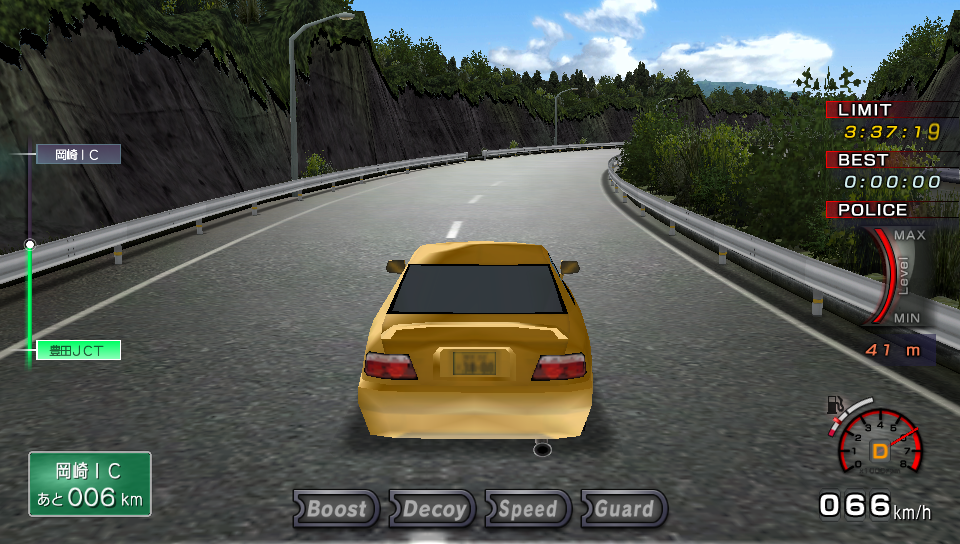
 That incredibly long title means it's once again time to look at that most beloved of budget game franchises, the Simple Series! It's a bit of a sad entry this one, too, since as far as I can tell, Simple V Series Vol. 2 The Tousou Highway Full Boost - Nagoya-Tokyo Gekisou 4-Jikan is actually the last ever Simple Series game. It's also  a part of the same subseries as a game I've covered in the past, the post-apocalyptic longhaul road trip Simple 2000 Series Vol. 112: The Tousou Highway 2 ~Road Warrior 2050~. Which means that it's also a Tamsoft game! We all love Tamsoft, right?


Anyway, like Road Warrior 2050, it' another longhaul road trip, though this time it's set in present-day Japan, and as far as I can tell you're getting briefcases to deliver them to the yakuza so that they'll release your secretary, who they've lock in a dungeon. While Road Warrior 2050's journey was punctuated by occasionaly sections where you fought waves of enemies on foot, Full Boost breaks up the long drive in a variety of other ways.


The game's main gimmick is that it's not intended for you to complete the whole journey in one car. Most of the vehicle types get damaged very quickly, and all of them have alarmingly small fuel tanks. Obviously, a car with no fuel can't go anywhere, and also if you're in a car when it explodes, that's an instant game over. Furthermore, a car's maximum speed gradually reduces as its fuel meter and structural integrity decrease. So, you get out of the car, and try to steal another one. This is a part of the game that's a little sloppy, though, as the only reliable way of getting a car to stop long enough for you to get into it is to let it run you over. Inexplicably, this doesn't hurt you at all.


Of course, the police aren't going to just let you go on your highway carjacking rampage, and they'll regularly come along to try and spoil your fun. If a police officer catches you on foot, or pulls you out of a stationary vehicle, they'll try and handcuff you, and getting free reduces your stamina a little. Running also reduces your stamina. Despite all this, it seems like the developers wanted to create a non-violent game, as you have no way of keeping the police away, even temporarily. So if there happens to be a few officers around while you're trying to switch to a new vehicle, it can be a little awkward and very difficult to get away with it.


The last thing I want to talk about is the power up system. There are power-ups strewn about the roads here and there, and collecting them progresses a Gradius-style power up chooser along the bottom of the screen, with four different things to choose from. You might be tempted by the quick thrill of selecting Boost every time you pick up an item, but honestly, it's worth saving up four of them each time to get the last option, Guard. What this option does is gives your current vehicle an impenetrable rainbow forcefield, increases your top speed to how it would be if your car was undamaged and full of fuel, and it stops your fuel meter from depleting while it's in effect. Practical and fun!


The Tousou Highway Full Boost isn't some grand swansong for the illustrious Simple Series to bow out on, but it is emblematic of the series at its best: it's a fun, unpretentious game with a lot of low budget b-movie charm. I do recommend giving it a shot, though it's a download-only Japan-only PS Vita game, so its legal accessibility isn't great, and it's only going to get worse as Sony continue their policy of gradually pretending the system never existed. Still, if you can get ahold of it, you should. It's fun.

Saturday, 7 December 2019

Uppers (PS Vita)

I really, really wanted to like this game. On paper, it has so much going for it: it's a modern beat em up that relies on neither ham-fisted nostalgia nor a grind-driven negative difficulty curve, and it has a ton of cool ideas and a lot of visual flair. It's all ruined, though, by one massive insurmountable flaw: it might not have a negative difficulty curve, but it doesn't have a positive one either. It's got a difficulty flatline. What I'm saying is that it's incredibly easy, to an extent I don't remember seeing before in an action game that wasn't made for very young children.

But I'll get back to that, after talking about the game's positives.  Like how all the stages have crowds of girls loitering around the place, and you can get statistical bonuses by impressing them with your fighting. Impress them enough, and they'll even give you love letters! There's also some weird slot machine thing involving them where you can win more bonuses, and a weird minigame that lets you lift a girl's skirt by tapping the X button fast enough for a few seconds. This stuff's all a little unseemly, but it is, at least, original. In fact, I don't remember a beat em up that has you trying to impress onlookers in this way. Surely it hasn't taken 30-odd years of the genre's exitence for someone to come up with this idea?

What I think is the game's best point is its use of weapons and the environment. Rather than being able to pick weapons up, carry them round and use them to clobber enemies, they're all instead parts of the stage. So you use the O button in the right place, and you'll swing round a lamppost to kick the enemies surrounding you, throw a motorbike into a crowd, or event flip a pick-up truck onto a group of foes. Conversely, you can punch, throw, and kick enemies into things to elicit effects: you can cause them to smash through walls, collapse piles of girders, explode burning barrells, and so on. Both these features really add an anarchic feel of mass destruction to all the fights, which is nice.

Of course, that brings us all back to the problem of the game's difficulty. All those cool ideas and visual bombast don't mean much when the game itself is easier than breathing. There's no tension, no friction, and no real excitement. Most of the enemies go down in two or three normal punches, meaning that you only need to use the cool environmental stuff for the tougher enemies and bosses. And even they don't put up much of a challenge. Uppers is definitely the game to play if you ever want to sympathise with Superman's "world of cardboard" speech. I've been playing for over two hours, with hard mode switched on, and still there's no challenge. It might well get harder at some point later in the game, but an action game really shouldn't make you play for multiple hours before getting to the "real" start of the game. Because if it does, then you're likely to just give up on it. Like I have given up on Uppers. One final note: it does have a proper printed manual, with colour illustrations and staples and everything!

Wednesday, 22 November 2017

Airship Q (PS Vita)

The first I heard of this game was that it was an import-only PS Vita game that had received an official translation, and instantly went and bought a copy, just because we really should reward the publishers who do good things like this, just as much as we should shun those who engage in unethical business practices like encouraging real money gambling and so on. (How topical! I feel lucky that none of the games embroiled in all this loot box controversy are even slightly appealing to me in the first place, though). Luckily, this all paid off, and Airship Q turned out to be a pretty good game!

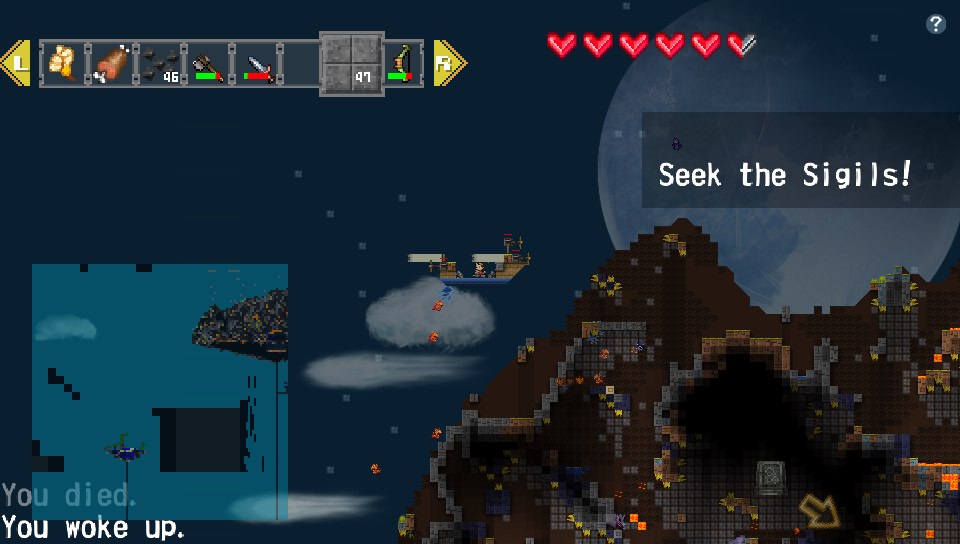
As you look at the screenshots, I'm sure you'll be reminded heavily of Terraria, and there's no denying that that game must have been a big influence on this one. It's by no means a clone, though, as while Terraria might have an end goal, it's also a non-linear game that takes place in a large, procedurally generated open world, with a heavy emphasis on building bases and so on, Airship Q is a much more linear action RPG ala Zelda, that happens to take place in a world of mostly-destructible blocks, and in which you gather resources to make your tools and weapons.

In it, you play as a girl living in a world of floating islands who built a flying ship with her brother, only for her brother to be kidnapped by a witch, who also turned the two siblings into cats. Your aim (at the start of your adventure, at least) is to rescue your brother, beat up the witch and regain your human forms. In the course of this, you'll seek out statues that let you build more and more pieces of equipment, from stronger mining equipment to pieces of machinery that improve your airship. You'll also eventually find out some secrets behind the world when your true quest is revealed (though since this is a pretty recent game that's still available to buy brand new, I won't spoil things any further). There's even the possiblity of a cheeky bit of sequence-breaking, if you're smart!

It's a lot of fun to play. Dungeons largely involve digging around and building staircases to climb, while simultaneously fighting off hoards of monsters and seeking out the statues hidden within. Exploration has a totally different feel, as you fly around on your ship seeking out islands and dungeons, as well as occasionally fending off attacks from flying monsters,and even huge dragons and enemy ships (dragons are usually guarding some important treasure nearby, while enemy ships are usually great sources for resources like big cannons to steal and attach to your ship, and coal to power your machines). There's also cool little touches like how structures need to be built in certain ways, since unlike Minecraft, everything will collapse in short time if it's not built in a sufficiently sturdy manner (though that's fine if you're just building a temporary bridge or whatever).

Again, I don't want to spoil all the cool little moments and touches that this game holds, so I'll end this review here with a strong recommendation. Airship Q is a great game, and you can pick up a brand new physical copy for really cheap, too!