Showing posts with label 32x. Show all posts

Saturday, 28 December 2024

Stellar Assault (32X)


 One of the (very) few games that stands out of one of the shining stars of the 32X's library is the port of Star Wars Arcade. So to make another 32X game in the same genre must either be a cynical attempt to cash in on that game's success, or a misguided attempt to try and compete with a game that has the advantages of being a tiw-in to a big mainstream movie series (though as has been forgotten by popular culture, Star Wars' cultural cache was probably at its all-time lowest in the first half of the nineties, it was still a hefty name to throw around), as well as being a port of an acclaimed arcade game and having some of the best graphics on the system.


But while Stellar Assault (also known as Shadow Squadron) might not seem like it has anything to offer in Star Wars' wake, it's still a pretty good game with plenty of its own charm. The graphics, for example, are a lot simpler and significantly less impressive than those of Star Wars, despite coming out a year later, but there's just something about these big spaceships silently floating in mostly empty space that creates a lot of atmosphere (ironically, since they're in space). Furthermore, there's some really cool stylisitc thigs in there too, like the start of the first stage, that sees your ship getting launched from a gigantic curved space elevator thing. I also like the constant presence of the sun, that you seem to get slightly closer to in each stage, and again: though it's just a flashing bright circle in the distance, it somehow feels a little more real in its understatedness.


The stages themselves are pretty simple, all of them being just "destroy all of the enemy ships", with some interesting enemies appearing on certain stages like the massive Accel Gate on the second stage, that sucks your ship in, to shoot it out of the other side like a projectile if you get too close to its opening. This doesn't actually damage you, but the first time it happens it's a pretty exciting and disorienting surprise. Mostly, though, there's a bunch of enemy fighters flying around, and a few larger ships just lurking about. The bigger ships are interesting in that you shoot parts off of them before they're fully destroyed, so you can tactically shoot off a bunch of ther guns as you go, if they're hassling you while you try to take down their fighter escorts.


Along with the games itself, there's a few interesting features that really give the game away as an early polygon-based game, and that that was something about which the developers were excited. There's a model viewer, which lets you spoil some surprises by looking at every 3D model in the game at your leisure (the aforementioned Accel Gate filling the whole screen in this mode!), as well as a mode that lets you change the colour schemes of not only the player ship, but also the enemy fleet. Make them the same, and pretend you're a pilot who's gone rogue and turned on your masters!


Stellar Assault is a pretty good game! Despite its simplicity I've enjoyed what it has to offer, and I think the visuals work really well in a fin example of "less is more". While researching this post, I also found out that there's a Saturn port/remake/sequel (I'm not sure which), so I guess I'll look into that at some point in the future, too.

Saturday, 23 November 2024

The Amazing Spider-Man: Web of Fire (32X)


 This was the final official 32X release, and coming out in 1996, I think there are two assumptions that can be safely made about it. The first is that it coming out was something of an adherence to the lost cause fallacy: possibly the publisher specifically had a license to make Marvel games only for the 32X, and they were going to do it whether it made sense or not. The second assumption is that it probably sold incredibly poorly, which is backed up by its modern day rarity and insane resale value.


Is it good, though? Not really. It's not terrible, either, though. Like most Spider-Man games of the time, it's a 2D platformer, you climb and swing acorss the stages, and the boss fights are against existing Marvel villains. Unlike some similar Spidey games, it does have a few stages that are designed in such a way as to allow you to freely web-swing over large swathes of the stage at your leisure. In fact, these stages are so long, that it'd probably take an absurdly long time to get across them on foot. Unfortunately, there's also a few stages that fall into the usual Spidey-traps, like being a long corridor with a surprisingly low ceiling, or being a bunch of enclosed boxes with small entrances and exits.


The plot concerns a plot by Hydra, who have set up a big laser net over New York (the eponymous Web of Fire), and are holding the city to ransom, plus they've kidnapped Daredevil and put him in a birdcage for some reason. After you rescue Daredevil, you can summon him to throw sticks at your enemies! So each stage ends with you fighting a villain in Hydra's employ, and destroying a laser generator, until you get to the Hydra airship/submarine/base stages. The bosses are probably the most interesting part of the game, to be honest, as the roster's made up of some absurdly little-known jobbers. People like The Eel, Thermite, Tangle, and others. 


Web of Fire is a game you mgiht want to look into out of curiosity: its rarity, status as the final 32X game, and weird villain roster are all points of interest (and what drew me into playing it). But if none of those things interest you, there's nothing else in the game that will, either. I played it way past the point of enjoyment to get screenshots, but there's no reason for anyone else to do that. And definitely no reason for anyone to pay £500+ for a real copy!

Sunday, 16 April 2017

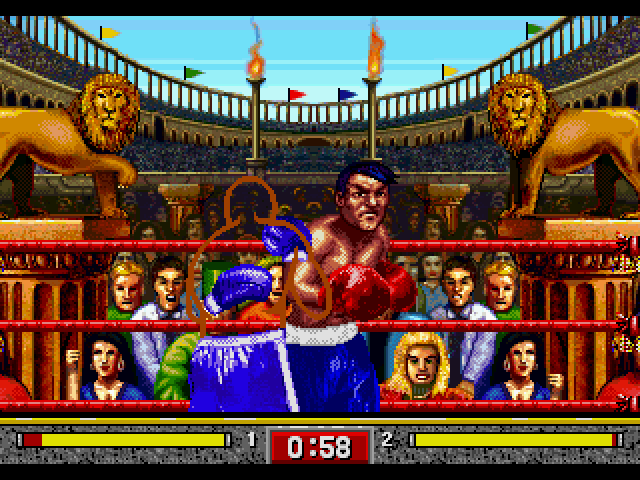
Toughman Contest (32X)

I never thought there'd be an EA Sports game on this blog, but it's game that's long forgotten, on a console that no-one cares about, featuring a sport that wasn't really popular for very long (and even when it was, it was never massive). Toughman Contest is an amateur boxing tournament that's been going since the late 1970s, but the only time I've ever heard of it was in the late 90s, though it apparently continues to this day. This game is vaguely based on that competition, though all the boxers in it are fictional caricatures with silly names.

Presentation-wise, it's a bit of a mixed bag in many ways: though the graphics are all competently drawn, the game has an ugly pseudo-realistic aesthetic, and the menus look cheap and low-rent compared to the game itself. The character sprites are all massive, taking up most of the screen, though whoever you pick will always be represented by a green outline. A nice touch is that there are four tounaments in which you can compete: North America, South America, Europe/Middle East and Asia/Australasia, and each of them has their own (heavily stereotyped, in a Street Fighter kind of way) arena.  As for how it plays, it's kind of like Super Punch-Out, but worse in every possible way.

Like Super Punch-Out, you view your boxer from behind, and you've got to dodge your opponent's punches and hit them back with the right timing. Unfortunately, it doesn't work as well as Nintendo's game, since in the name of realism, there's no tells when any of your opponents are going to attack or dodge or block, and it just feels like everything happens at random. Sometimes you won't get a single hit on your opponent the whole match, other times, you'll pummel their face in by simply holding up and C. There's also times when your opponent's health will just randomly drop to nothing, a mechanic which I assume is supposed to represent a lucky suckerpunch? Another problem is that I've played plenty of matches, and have never won nor lost by knock-out. Every match has been decided by judge's decision, which also feels slightly random. The final result usually makes sense, and the most successful boxer will win, but it could be a fight where you didn't get a single hit in, and you'll just barely lose by one or two points. Conversely, you could batter your opponent into paste, and just barely scrape a couple of points ahead of them.

I saw screenshots of this game, and gave it a shot, hoping it might be a diamond hidden in the substantial rough that is the 32X library. But it's just another ugly, boring game that's outshined by better titles on less powerful hardware. Oh well, never mind.

Friday, 1 June 2012

Metal Head (32X)

The 32X, like the Mega CD has a reputation for being a worthless albatross. Unlike the Mega CD, it kind of deserves that reputation. It doesn't have many good games at all, and most of the ones it does have are ports (Doom and Virtua Fighter, for example).
Luckily, Metal Head is both a fairly good game and a 32X original. If you also add the fact that it has probably the best (or at least, the most technically impressive) graphics on the system, it's surprising that it isn't more well known.
It's a 3D shooting game, in which you pilot a robot around city streets and underground bases shooting terrorists, who themselves have their own robots, plus tanks, hoverbikes, jeeps and various other things.
The stages each have different objectives, which are all simple tasks like "kill all the enemies" or "find the enemy's hideout". At the end of each stage you get awarded points, based on how many enemie you killed, how quickly you finished and how much ammo and health you have left. These points can be spent every few stages on weapons and other upgrades. One feature that is both strange and annoying is that none of the upgrades are permanent: you start with a grenade launcher in the first set of stages, but if you want to use it later, you have to buy it again. Likewise, you can also upgrade your machine gun, but this needs to be done every time.
As mentioned earlier, the graphics are really excellent, considering the hot console. You could easily mistake MH for an early Saturn or Playstation game! The most impressive thing is the fact that everything is texture mapped, and though the textures are very low resolution (the game did come on a cartridge, after all), it really does add a lot to the look and feel of the stages.
The controls are okay, though they'll seem very old fashioned to people used to modern twin-stick 3D shooting games. The d-pad turns and moves, and there are buttons for shooting, cycling through weapons, running and looking left and right. The biggest omission is the lack of strafing. There is a surprise in that the "Mode" button is used to change the camera angle. I didn't know that button could actually be used for in-game stuff. Is Metal Head the only game that uses it like this?
There's also a fairly long (and unfortunartely, quite boring) intro with voice acting, if you like that kind of thing.
I think I've said enough about the game itself now, so I'll tell you about two quite strange options the game has.
The first allows you to change the speed of the game's music. It sounds fine as it is, though, so I leave it at the default. Actually, I should mention that the music in this game is pretty good, and I do find myself humming the intro theme from time to time. It's a shame that whewn you're actually playing the game, it's drowned out by the sound effects, really. I can only assume that this option only exists because the programmers discovered that it was a neat trick the 32X could do?
The second weird option is the one that lets you choose the style of the character portraits. You can choose between photos of real people (which look really weird when animated along with the voice acting) or cartoony drawings of them. This doesn't have any effect at all on the gameplay, and also, the characters in the two options look completely different to each other.