Showing posts with label msx. Show all posts

Saturday, 17 May 2025

Mon Mon Monster (MSX)


There's two particular types of nonsense that have long since been exorcised from the language of modern games design. Rick Dangerous nonsense is when a game's made up of nothing but memorising the locations of invisible threats, and then demonstrating that knowledge to avoid them in succession (because they're invisible, and it's impossible to avoid them without foreknowledge of their locations). The other is Tower of Druaga nonsense, whereby progression through a game is blocked by obstacles that need to be tackled in a certain way, with no in-game clues as to what those means are, or often even that the obstacles themselves even exist. Mon Mon Monster (also known as Mon Mon Kaibutsu) is an example of the latter kind.


The first stage is pretty normal, to lull the player into a false sense of security. It's split into a few segments, but each one just has you going from left to right fighting enemies and punching blocks, until you find the door to the next one. Eventually, you'll reach the boss, and can punch him to death. The second stage is a lot less clear. It seems to take place on one massive map, there are doors that lead nowhere, doors that send you to an earlier part of the stage, and the boss awaits in a hidden room, behind two destructible walls that don't stand out in any way, and have no clues pointing towards them. The third stage seems to take a moderate place between the previous two, being semi-linear with dead end passages if you take a wrong turn. Though I haven't yet been able to reach the end of stage three, so maybe there is more nonsense to look forward to there.


I should probably also describe the game itself, right? Well, other than the implementation of Druaga Nonsense, it's a pretty typical eight bit platform game. You play as a little Frankenstein's monster guy, and you can punch and jump. When you punch, you also shoot out a projectile attack. Enemeis can be hurt by punchs and projectiles, but bosses and blocks have to be punched up close. Sometimes blocks have items in, that might power up your projectiles, restore your health, or give an extra life. In terms of quality, it's not up there with the big names of the era, but it's still a little above average. It mostly feels good enough to move around, jump, and so on. There's a weird technical quirk that means your projectiles are sometimes invisible, but they still hurt the enemies, so it's not a big problem.


That's all I really have to say about Mon Mon Monster, to be honest. It's a robust enough platformer, especially considering its age, but I just don't have the patiences to keep searching for invisible routes to progress. Other than that stuff, though, it's not that difficult a game! If only the developers had designed their stages without the assumption of clairvoyance on the part of the player, this would have been a much better game.

Sunday, 14 July 2024

Small Games #9!


 It's been three years since the last small games post, but I was recently playing random MSX games and discovered two platform games that were cute, fun, and interesting, but not really complex enough to carry posts of their own. The first is the oddly-titled Rise Out From Dungeon, and it's a little bit of a Lode Runner knock off, with gold bars, pursuing guards, and the ability to temporarily destroy the blocks that make up the platforms.


The way the guards move in particular is very similar to Lode Runner: they'll try to match your position horizontally before trying to match it vertically. They'll follow this pattern even if it means getting themselves trapped or falling to their deaths! It's the differences that really make it worthwhile, though. Firstly, your digging tool is very different to the one in Lode Runner. Rather than diffing a hole in one of the blocks next to the one on which you're standing, you instead have a gun that lets you shoot away blocks on the same height as you, even from across the screen. 


The other big difference is that you don't have to collect every gold bar before exiting the stage. Some stages have locked doors, and one of the bars will contain a key that you have to find before you can open the door, but otherwise, you can just rush to the exit if you aren't bothered about score. I really like the way this game looks, with your character represented by a little white stickman, and the enemies are red stickmen. It's all very tiny and cute, almost the bare minimum amount of pixels used to represent each object in the game.


The other game I'll talk about today is Tensai Rabbian Daifunsen, in which you play as a lagomorph dockworker, trying to get crate to a ship while being chased and harassed by villainous white blobs. It's a platform game with stages that are only one screen wide, but they scroll vertically. You start at the top of each stage, and there's crates littered about (but not randomly!). When you walk past a crate, it drops down to the platform below. 


At the bottom of the stage, there's a cargo ship sailing back and forth, and you've got to get all of the crates onto it. Or at least, as many of them as you can. There's no penalty for just dropping crates into the ocean, but getting them on the ship is essential for getting a good score. There are also blocks that can be hit from below to reveal power ups, like in Mario, though it's slightly awkward in that they don't move, so you've got to descend, hit the block, then climb back up to get the item. It's usually worth it, though, as there's a common carrot item that temporarily makes you invincible, and a rarer yellow smiley face that just immediately ends the stage (good for progress, but very bad for scoring). Both these games are great, and I definitely recommend you give them a try, and it feels like a great bit of luck that I found them both consecutively.

Friday, 23 February 2024

Haunted Boynight (MSX)


 This game's also known as Youkai Yashiki and Haunted House. I have no idea where the "Haunted Boynight" name comes from, but that's what it's called in many romsets, and it's a lot more eyecatching than the other, probably more legitimate titles, so that's the one I'll use. It's a surprisingly complicated and ambitious platform game that's not quite a search action game, but a little more complex than a traditional platformer.


You play as a boy, going into a haunted house to save your sister, who is apparently a renowned paranormal investigator who went missing there. (At least, that's what a comment on a Youtube playthrough says the plot is, anyway. That video and its comments being pretty much the only source of useful information on this game that I've been able to find). Your only weapon is a flashlight, which damages ghosts when its light hits them, and that's where the first really weird thing comes in. When you start the game, your flashlight is a melee weapon, but if you use it to dispell the wisps in the garden leading up to the house, it'll start shooting a projectile, until you get hit. This also does something to make you stay alive longer, but the way your health and lives work in this game is enough of a mystery that I never fully worked it out.


The basic goal of each area is pretty simple: find five paper talismans, whih will then turn into a key that'll allow you into the room where the boss is. You have to find the boss room yourself, of course, and as the game goes on, the stages get bigger and more byzantine in their layout. Therer does tend to be more than five talismans in each stage, though, and your surplus get carried over. In fact, I'm pretty sure that the game is actually a big open world, with more areas getting made accessible with every boss defeat. I'm not totally sure, though, as the only time I went back to a previous stage was by accident. Because there are what look like stone firepits dotted around all the stages, and when the fire's not shooting out of the top of them, you can stand there and press down to get taken away to somewhere else that might be hell or might just be a network of caves under the house? And there are also firepits down ther that'll take you back to the house, not necesserily in the same place you left it, though.


Another thing that won't be immediately obvious are the little monk statues standing around in certain places. If you touch them while carrying a rice ball and a depowered flashlight, they'll take the riceball and repower your flashlight. But they also have a second function! Stand in front of them and press down, and a small part of the wall or floor nearby will disappear, opening a new path. This is actually necessary to get into one of the boss rooms! The bosses themselves are the most mysterious of all. They all have one very specific weak point that's not at all obvious, and I only figured out most of them for the four bosses I fought by watching the aforementioned playthrough video. Sometimes the weak point is easy to rerach, and needs to be hit a bunch of times, sometimes it's hard to reach and only needs to be hit once. But again, in almost all cases, it's not something you're likely to figure out on your own. I wonder if all these "secret" things were listed in the manual, or if this is a game that just wanted to extend its playtime through obtusity?


To be honest, this isn't a great game. Like I've described, it's mostly about figuring stuff out either through luck or through looking it up online. The first stage does do a good job of creating a ver Japanese haunted house atmosphere, but it's unfortunately a case of severe frontloading, and the following stages just feel like some generic 8-bit microcomputer platformer world. This isn't one you should seek out and play yourself. Maybe just play through the first stage, for the atmosphere, but don't bother going any further.

Monday, 6 July 2020

Pleasure Hearts (MSX)

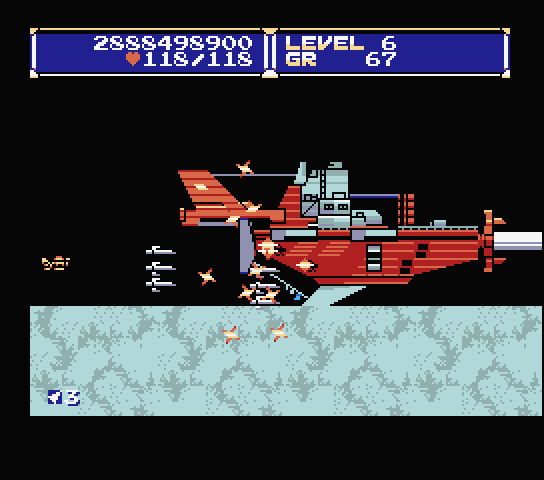
Pleasure Hearts is one of the early works of M-Kai, a developer who would go onto later fame through his Wonderswan game Judgement Silversword, and even later than that, the XBox 360's Eschatos. Though it's an early work, you can already see that he's a developer with plenty of ability in both programming and game design. In fact, this might be the best-looking game on the MSX (discounting laserdisc games, of course), with all kinds of animation and scrolling tricks in effect.

Luckily, it also plays really well. Though it might look like an old-fashioned horizontal STG, it actually occupies a space in between old-fashioned games like Gradius and the like, and faster danmaku-style games, which had already been populatr in arcades for a few years by the time of Pleasure Hearts' release in 1999. Bullet patterns are mostly confined to boss fights, though, with the stages having large crowds of small enemies each firing individual bullets directly at you, often at different speeds. This is a really strange paragraph to read, isn't it? Sorry about that.

Basically, it's a fast and fun and very high quality game. Interestingly, for a game on an 8-bit system, the scores go really high, really quickly, and score growth seems to be exponential: I tend to hit the one billion mark around the start of stage four, and only a stage later, I'm already at three billion! I'm not totally certain on this, but there is a bullet graze counter among the various other stats and meters at the top of the screen, and I think this acts as a multiplier on the points diamonds that are dropped by some enemies, and which your bombs turn bullets into. Like I said, I'm not 100% certain of that theory, though.

There's even some kind of plot in the game, as evidenced in the optional prologue stage, which sees a fully-powered up ship with a massive score at the end of some grand adventure getting betrayed by its allies and ultimately destroyed by a giant dragon. Presumably, then, the game's plot is about seeking revenge on the traitors and their dragon? I'm only guessing, of course. There's no text or anything as far as I can tell, and it would presumably be in Japanese anyway, even if there was.

I could keep writing about how great this game is, but if I did, it really would be just that: a stream of compliments directed at every aspect of the game. Obviously, I strongly recommend that you go and play this game as soon as possible. It's very easily available online, since M-Kai himself released it and his other MSX games as freeware back in 2009, so go and find it, load it up in your MSX emulator of choice, and have a great time!

Monday, 4 May 2020

Magical Tree (MSX)

The great thing about writing about obscure stuff is that sometimes, you find something great, and can then go on to show it off to everyone, so they can enjoy it, too. This is one of those times. Magical Tree is an MSX platform game about climbing a tree. I first tried it out, because I saw the boxart, and thought it might be a clone of Noboranka, the arcade shooting game about climbing a tree. I was wrong, but luckily, it turned out to be better than that anyway.

I'm sure I've mentioned before the concept of "pure" game design. Don't confuse purity with quality, it's just a stylistic assessment. What I mean by it is a concept that was more common in the eighties and early nineties than it is now: videogames in which each element, be it an enemy, an item, a part of the stage ,or something else, serves a specific in-game purpose and is easily identifiable from the other elements around it. Obviously, this kind of thing is much easier to do in simple, old-fashioned, arcade-style games like this one, but it's something you can also see in Minecraft, which is probably one of the most complex videogames of all time. I'm bringing it up here, because Magical Tree is a game that has this purity, and it does it well.

It is a very simple game: you go up the tree, avoiding enemies and collecting points items. At certain score thresholds, you get extra lives, so there's an incentive for playing for score, if that's not enough of a motivating factor for on its own. But like I describe above, you can easily learn how each enemy type acts, how certain objects interact with certain stage elements, and so on, to figure out every way possible of maximising your score, and of surviving to climb a little higher up the tree. Luckily, along with all of that, it is actually fun to play the game and do all this stuff.

One little stylistic thing that I think adds a lot to the game, and how addictive it is, is the constant on-screen tracker of how far up the tree you currently are. It's a constant reminder of your progress, and an easily-remembered benchmark to compare against earlier runs. It's probably copied from the "how high can you get?" screens, but they only appeared between stages, in twenty-five metre increments, while this counter is constant, and counts every metre you climb. It's just satisfying, you know?

Obviously, I recommend that you play Magical Tree. It's fun and cute and addictive. It seems that I keep finding more and more MSX games to love as time goes on, and while other Japanese microcomputers might have excellent graphics or music, it's the MSX's games that keep me coming back most often.

Thursday, 5 March 2020

The Fighting Wolf AT (MSX)

For such an early entry into the belt scrolling beat em up genre, and from a relatively small company like Technopolis Soft, it's impressive how versatile the controls in The Fighting Wolf AT are. With only a D-pad and two buttons, you can walk in eight directions, punch, kick, and even duck and jump! Unfortunately, you only ever have to walk left, walk right, and punch, and in fact, doing anything else will diminish your chances of survival.

So, each stage consists of a few screen's worth of a repeating background, though it doesn't matter if you walk to the end or not, only that you defeat every enemy. Although it would be more accurate to say that rather than "beating every enemy", you're beating enemies until they eventually stop spawning. Each stage has exactly two kinds of enemy: one that spawns on the right of the screen, and one that spawns on the left of the screen. Beat one, and an identical one will take its place. Keep doing this and after a couple of minutes, you've beaten the stage.

I don't know how long the game is, but the technique that got me to stage five (the enemies do gradually become more enthusastic about trying to fight back, and you only get one life) is just to repeatedly punch one enemy until it's dead, then turn around and punch the enemy on the other side until they're dead. By then, the enemy on the first side will have respawned and walked up to you, so repeat the process. And that's pretty much the entire game. The background changes each stage, as do the sprites for the enemies, but they all play the same.

There's not much more to say about this game. It looks okay, except when the screen scrolls, and the music isn't terrible I guess. The best thing I can say about it is that the enemies in th second stage are a woman and a baby, which is kind of odd. Don't play The Fighting Wolf AT, it's rubbish.

Monday, 11 November 2019

3-D Bomberman (MSX)

Though it seems like an obvious thing to have tried at some point in the mid-00s, maybe around the time of the awful Bomberman Act Zero, as far as I can tell, this game from all the way back in 1984 is the only attempt at a first-person Bomberman game. To put that in perspective, I don't even think anyone involved had even realised the multiplayer potential for the series at this point! Obviously, this doesn't use polygons, or even sprite scaling for its 3D effect, instead using Phantasy Star-style dungeons to stage an action game.

By that, I mean they're mazes with identical walls, where your movement is in pre-determined steps, and you can only turn in increments of ninety degrees. This wasn't the only action game from this era to use such a setting, with the most famous example in the UK being 3D Monster Maze, released in 1981 on the Sinclair ZX81, a computer with significantly less power than the MSX. An important difference between that game and 3-D Bomber Man though, is that while 3D Monster Maze had the player as a passive participant, running and hiding from the T-Rex in the maze, the player in this game is tasked with killing the enemies (malevolent green balloons, the eponymous floaters from the UK's localised version of the first Bomber man game, Eric and the Floaters), by dropping time bombs in the grand Bomberman tradition. You can also escape from the maze by finding a ladder, but you don't get any points for this, and I'm not sure if the game has an ending to reach.

The game's execution is about as good as can be expected with the technology of the time, with two small exceptions. Firstly, each of your steps covers the distance of half a block in the maze, which, couple with the stiff 90 degree turning, means you can sometimes get stuck on corners for a few seconds, which can be annoying when you're being chased. The other problem is that there are two types of wall: the indestructible outer wall of the maze, and the destructible walls within, and they both look identical. You do have a small radar that only shows you, the enemies, and the outer walls, but it's a weak compromise. There are other problems, but they're not so much problems with this game, but ways in which someone playing it in 2019 can see that it could have been improved upon with more advanced technology: things like atmospheric stereo sound, the ability to peek round corners, and move in directions other than backwards and forwards would all have added a lot, but obviously wouldn't really have been possible in 1984. Which makes it stranger that it's not an idea Hudson ever revisited, as far as I know.

3-D Bomber Man isn't a bad game, but at the same time, it's more interesting than it is good. It's worth playing out of curiosity, but not much more than that. Also, since I mentioned it at the start, I want to point something out about Bomberman Act Zero: while everyone laughed at that game's attempt at applying a dystopian sci-fi aesthetic to Bomberman, the real problem it had was that it was barely a game at all: the single player mode consisted of 100 identical boring stages, and the multiplayer mode was only playable online. And even then, you could only play in that one stage that's in the single player.

Sunday, 6 October 2019

Small Games Vol. 5!

It's time for another batch of lower-key games, and once again, it's an MSX edition, simply because everyone loves the MSX, right? Unfortunately though, it, like all systems, played host to some pretty terrible games over the course of its life, and today's post is a bit of a good game sandwich, with bad games as the bread. The first slice being American Truck. It's one of those top-down see-how-far-you-can-go crash-avoiding psuedo-racing games that longtime readers will know I love. It's a pretty bad example of the genre, though.

It's just got a lot of little things wrong with it that all add up to a game that's no fun to play. The scoring system is bad: you only get points for destroying other vehicles, so there's no points gained for distance travelled or leftover fuel or time (though this does make me wonder if the developers were inspired by Goliath, the evil truck from Knight Rider). Instead of the usual fuel meter that acts as a combination time limit and health bar, you have three lives, one of which is lost if you touch the edge of the road, or if you so much as graze one of the black circles (presumably open manholes?) dotted around the place here and there. Also, at least once, I died from crashing into a vehicle, even though this is the only way to score points. I wish this game was better, but it just isn't. Don't bother with it.

Next up is a much better game, A.E., a simple single-screen shooter that was recommended to me years and years ago, though I've unfortunately forgotten by whom. If it was you, sorry! Though this game might like incredibly simple and primitive in screenshots, in motion, it's a different story. The backgrounds are completely static, but the enemies fly around them, and a kind of primitive psuedo-sprite-scaling effect has the swooping in and out of hollow meteors and slaloming through stalagmites and stalactites, and so on. It's a really cool effect that really shows how creative the devs must have been. The game itself is okay, too. Mechanically, it manages to stand out by giving you a fairly unusual weapon: your shots travel upwards for as long as you hold the fire button, detonating into an explosion that lasts a couple of seconds when you release. The enemies come in waves of six that fly away after a few passes. You clear a stage when you manage to successfully wipe out three waves. A.E is a decent game, and I pass on the recommendation I received onto you.

Finally, the second slice of bad game bread is The Komainu Quest, a game that I almost feel bad for badmouthing, since it was originally made as a promotional game for the town of Seto in Japan. I still will though, because it's awful. In contrast to A.E, which seemed to be made by developers who knew both the hardware they were using, and the extent of their abilities in using it, The Komainu Quest is rendered pretty much unplayable, apparently thanks to developers biting off more than they could chew in attempting a scrolling shooter on the MSX hardware (though that has been done by others, before anyone points out, and with spectacular results, too. But that's a story for another day). I say "attempting", because this game doesn't actually have scrolling. Instead, the screen slowly updates as you play, in columns a few pixels wide. The result of this is that sometimes you have enemies already firing at you several seconds before they actually appear, and even stationary obstacles pushing your ship out of the way when all you can see is empty sky. I feel bad for saying it, but The Komainu Quest is only worth playing out of historical curiosity.

Monday, 22 April 2019

Ninja Savior (MSX)

The first thing you notice about Ninja Savior, and the first thing I'll tell you about it, is that despite being made in Europe in 2015, it manages to look, sound, and feel like a Japanese MSX game from the mid-1980s with incredible authenticity. Considering how fake a lot of similar endeavors end up feeling, I think this is something worth mentioning and applauding. So well done on that front, Revelo! But authenticity aside, is the game actually good?

The answer is a resounding "yeah it's alright I guess". It's a very simple game in which you play as a ninja, jumping from one tower to the the other, while trying to exorcise a series of demons. You do this by collecting the talismans and scrolls hanging in the air between the two towers. At the same time, there'll be one or two smaller demons in the gap too, who hurt you if you touch them. Every time you jump, the talismans, scrolls and lesser demons change position.

 Your jumping arc is always the same, and when you're not jumping, you're sliding down the tower. So it's an action game controlled with one button and no directions, based entirely around timing. Also of note is that rather than a traiditonal health bar there's a kind of momentum bar with an X at one end, an O at the other, and a square moving along it. When you collect a talisman or scroll, it moves towards the O. When you land after a jump or when you hit a lesser demon, it moves towards the X. If it reaches the X, you lose a life, if it reaches the O, you go to the next stage. And that's pretty much all there is to know about this game.

Ninja Savior's a game that's very OK. It's not bad and the one-button controls and momentum meter are interesting, but it's not particularly exciting, and it's way too easy. Maybe if later stages had moving enemies or something that would have spiced things up a bit? Anyway, it wouldn't hurt to give the game a try, but it won't change your life either.

Thursday, 27 December 2018

Buddhagillie (MSX)

In the US and UK, at least, Wisdom Tree's selection of platformers about biblical figures carrying things on top of their heads are what we mostly think of, when we think of religious videogames. They also have a reputation (that they totally, one hundred percent deserve) for being awful to the point of near-unplayability. But of course, there are videogames with religious themes other than those relating to Christianity in the world, such as the 2006 Judaism-themed adventure game The Shivah, and though I can't remember the name, I definitely remember seeing a video of an Islamic-themed Tomb Raider-like a few years ago. And more infamously there's a game about (possibly even by?) the Aum Shinrikyo sect on PC88. But, as you might have gathered from the title, Buddhagillie is a game about Buddhism.

You play as the Buddha, with the aim of making all sentient beings your equal. This is done by going into hell and fighting the four sufferings (birth, aging, sickness and death), and absorbing the karma they spit out to power your mantra. You can only fly around the left half of the screen, you see, and the beings you hope to free from the circle of reincarnation: demons, asura, humans, gods and so on, all appear on the right side of the screen. So you have to use you sword to absorb karma, to power your mantra nad fire it at them. In gameplay terms, you slash small enemies with your sword by tapping the attack button. Holding the attack button lets you block their bullets, and absorb them. After you've absorbed bullets, you'll shoot your own on the last attack of your three-slash sword attack chain.

So, this is basically a decently-designed shooting game, with a few interesting ideas, and even a proper scoring system. Though those aren't surprising, since it's a homebrew game from 2018 released for free on the internet, and not actually a commercial MSX game from the 1980s. Whether you interpret it as an actual work of religious devotion, or you just see the Buddhist content as a bit of aesthetic flavour, it can't be denied that it does make the game stand out: there's not many games that look like this in the world, or that have selected quotes from the Buddha onscreen at all times.

But is it actually good? Yes! Like I said, it's got interesting ideas, and a proper, functional scoring system (that mainly centers around killing multiple small enemies with one three-hit chain), and it's pretty addictive, too. The only real complaint I have is the fault of the host hardware, rather than the game itself, and it's that there's quite a bit of sprite flicker, and it's very frustrating getting killed by a temporarily-invisible bullet.

Wednesday, 25 July 2018

Small Game Round Up Vol. 2!

It's time for some more ancient games that are too simple to support entire posts on their own! Today I'll be talking about just two games, both on the MSX, and the first is Godzilla vs. 3 Major Monsters, also known as Gozira 3D, for some reason.

It's a single-screen action game, that's just barely above the level of complexity of a handheld LCD game, or possibly one of the more advanced Atari 2600 games with slightly better graphics. The action all takes place in a classic tokusatsu rocky desert, and starts with Megalon emerging from holes in the ground. Obviously, you play Godzilla, and you just blast him with your atomic breath. Do this 10-15 times (I think Megalon has to have dug at least eight holes before this stage ends, as opposed to reusing ones he's already dug), and Megalon will be replaced by two Kumongas (they're really being generous with the term "major monster" in this game, aren't they?)

The Kumongas will pop up out of the holes at random, to shoot webs and energy bolts at Godzilla, like a more aggressive whack-a-mole game, and I think you have to hit each one three times to be rid of them. The final, and easiest enemy you have to face is King Ghidorah, who slowly flies down from the top of the screen occaisionally shooting a gravity bolt, but mostly doing nothing. Just blast him until he goes, and the whole thing starts again, but slightly faster. It's nothing spectacular, but it's an okay diversion for five minutes or so. Also, the Godzilla sprite looks great when walking left or right (but terrible when walking up or down).

The other game I hve to talk about today is one of possible historical significance, and very little else. Nyannyan Prowrestling might be the first ever women's wrestling videogame. It came out in 1986, the same year as SEGA's Gokuaku Doumei Dump Matsumoto, though I haven't been able to track down an exact date for either game, so I can't say for certain which was first. Even if SEGA got there first, this might still be the first home videogame about women's wrestling, if it came out before the 20th of July that year (when Gokuaku Doumei Dump Matsumoto's Master System port was released).

Anyway, other than that bit of trivia, there's not much positive to say about this game. All the wrestlers have the exact same sprite, it uses a bizarre menu-based control system (though to be fair, a few early combat sports games did this, including the Boxing and Pro-Wrestling games on the SG-1000. There's a lot of SEGA talk in this review, isn't there?), and for some reason, all the matches take place on basketball courts instead of wrestling rings. On top of all that, you have to play it with the keyboard, as it doesn't acknowledge controller inputs! There's not much more to be said about this game. It's an interesting historical footnote, but not much else. Don't waste your time, except to satisfy your curiosity.

Thursday, 28 June 2018

Akanbe Dragon (MSX)

This is a game with an interesting premise, and the quick and easy way of describing it would be to compare it to a combination of chess and the Game Gear game Godzilla Kaiju Daishingeki (though it predates that game by a few years). Unfortunately, it scuppers all the goodwill generated by the concept through a few terrible design decisions.

I have to make an admission here: I never got past the first stage of this game. I played for hours, and made many attempts, and I did come close a few times, but in the end, the odds are stacked way too heavily against the player. But I should get onto actually describing the game. There's a map with a grid on it, and each square contains a different kind of terrain: mountains, plains, water, and so on. At the top and bottom of the map, there are two groups of monsters, the player at the bottom, and the enemies at the top. Each type of monster not only has four stats: HP, strength, speed, and jump, but they also have a chess class, which affects how they move on the grid (and like in chess, the aim is to kill your opponent's king).

When two monsters try to occupy the same space on the map, the game has them engage in a real-time, side-view, no time limit battle to the death. All the monsters attack by shooting stuff, though there's still a fair bit of variety in the attacks: some can fire a bunch of shots that quickly go in a straight line, others might only be able to fire off one shot at a time that takes a more wibbly path that's harder to dodge. Though the AI seems pretty good at moving its monsters around the map to keep a tactical advantage, in battle, the enemies all seem to just randomly bounce around the screen shooting at random. They'll still win a lot though, due to the game's biggest flaw: no matter what the situation, the enemy monsters always have significantly higher stats and more HP than your own, making every battle a precarious and miserable slog. Making things more annoying is how the strength is dealt out among your own monsters, with your pawn (amusing mis-spelt ingame as "porn") being second only to the king in strength, while your queen and knight are so weak as to be almost completely useless.

An interesting aside is that entering battle with the enemy king does something slightly different to normal enemies: he has his own specific battleground that overrides whatever terrain type on which you encounter him, and the battle feels more like a boss fight from a platform game. As far as I can tell, the best strategy to take is to get as many of your monsters to fight the king and wear him down before sending your king in to finish the job. I almost won with this method, but I guess the enemy had the same idea, as by the time the enemy king had taken out all my underlings, my king was weakened doing the same. On my last attempt, my king succumbed with only a sliver of the enemy king's health left. Unfortunately, I'd completely lost all patience with the game by this point, and had no desire to make any further attempts.

It's honestly a shame, as I really wanted to like Akanbe Dragon, but the atrocious balance means that I can't recommend it at all. If only playing it didn't seem like a futile uphill struggle, it mgiht have been a hidden classic.