Showing posts with label game boy advance. Show all posts

Saturday, 7 February 2026

Taiketsu! Ultra Hero (GBA)


 Can you believe it's been over two years since I wrote about a tokusatsu tie-in game here? And even that's if you're liberal enough to count Power Rangers as tokusatsu. Don't worry, though: there's going to be more than one post on this subject this year, I'm pretty sure. This one is an Ultraman fighting game! There's been many of them, some notoriously awful, some sneakily having little cult followings. This one is closer to the first group, but I wouldn't go as far as to say that it's awful.


It's got a pretty big roster of characters, with a bunch of Ultramen selectable in "VS Mode", which is actually what you'd normally think of as arcade mode, and tournament mode, where you only fight against other Ultramen. There's also a Free Battle mode, in which you can select any of the monsters that you fight against in VS mode, including a screen-sized representation from one of the great old ones of the Cthulhu mythos, Ghatanothoa (or rather, "Ghatanothor", as the Ultra series officially spells it), who apparently appears as the final enemy in 1996-97's Ultraman Tiga (which I unfortunately haven't seen). More importantly, yes: you can play as Dino Tank in this game.


There's some things that are very strange about this game. Firstly, there's the balance. All of the monsters are massively more powerful than all of the Ultramen, in every mode. They do more damage with their attacks, they receive significantly less damage from attacks, and most of all, they can use their special infinitely. Ultramen have a power meter at the bottom of the screen, representing their Color Timer. It slowly goes down constantly, with special moves taking chunks out of it. There's even some "all or nothing" specials that can immediately win a fight if they hit, or lose it if they miss! So, this imbalance is clearly a deliberate choice to add tension, and stay close to the lore of the TV shows. It makes for a worse game, but a better adaptation. What a conundrum!


Another weird thing, that can't be so tidily excused, is the way special moves are performed. Instead of having move inputs like a normal fighting game, instead you hold a shoulder button and press a face button to perform specials. So every character has a maximum of four specials, and it's not really possible to make combos with any of them. While the face buttons are each assigned punch and kick, the shoulder buttons don't do anything when pressed on their own, so I wasn't even able to figure out this weird system on my own! Instead, I saw that there must be specials in the game when I saw CPU opponents performing them, and went looking online. Luckily, there is a guide on gameFAQs (written in 2004, a mere six months after the game's release!). It doesn't work well, it's not fun to do, and it's not very intuitive. 


There's good things about the game, too. Like how it looks: all the sprites are really well-drawn and animated. And while it's technically a bad game, there's still a little bit of entertainment to be had from having monster vs monster fights in free mode. And then learning that it's still hilariously poorly balanced, since any monster that has a projectile with full screen range can just spam it with impunity. If you fire up the ROM, I'm sure you'll be amused for like, half an hour or so. That's fine, right? I haven't been able to find a copy for sale, so I don't know what the prices are like for it, but whatever it costs when it does emerge: it's not worth it.

Sunday, 15 December 2024

Oriental Blue: Ao no Tengai (Game Boy Advance)


 I was first drawn to this game because it was an RPG with an east Asian fantasy setting and also a lot of really nice pixel art. There's also some nice full screen cutscene pixel art, though it only shows up fairly rarely, because of the way the game's structured. Which brings up the big surprise I got from playing Oriental Blue: it's an open world game! On the Game Boy Advance! Like is so often the case, western publishers were very short-sighted and didn't bother translating it. The post-Pokemon/Tokyopop English anime and manga boom was still ongoing, as was the post-Final Fantasy VII RPG boom, and here's a really high quality RPG owned by lots of kids, with a sertting they'd love and an amazing selling point, and apparently none of them were interested. 


Luckily, it did get a fan translation a few year later, so you (and I) can play it without having to read Japanese. There's a lot of plot threads, but it all starts in a large city, where a big ritual is about to take place, and there's apparently also conspiracies afoot. The ritual fails, and there's also monsters roaming the streets, and bad stuff happening across the land, too. One particularly interesting thread I picked up involved the Oni. They're depicted as a stand-in for indigenous people (which is also done in the TTRPG Tenra Bansho Zero, which was orginally published a few years before this game. Is this a common trope, or is there a specific bit of direct inspiration going on here?)


The Oni are suffering some severe oppression at the hands of humanity: forced to live in a barren mountain village, subject to raids by slavers, and treated like dirt if they go to human settlements of their own volition. One of the first quests I got myself involved in was trying to re-claim a stolen Oni artifact from a human lord's palace, but it turns out to have been stolen again from him by a mysterious theif/murderer. I as worried that the Oni stuff would have been some passive background thing, just "that's how it is, I guess", but during that quest, one of them joins your party, with a view to improving the lot of his people and faning and getting their treasure back.


Unfortunately, I eventually ran into a big problem: I was finding the starts of plot threads and questlines, but I wasn't able to actually advance any of them. Ships were stuck in docks, valleys were blocked by boulders, and other barriers stood in my way in various places, all making it so I couldn't go to new towns, in each of which I was sure at least one "next thing" I needed must be waiting. I'm sure eventually I'd be able to figure some way of making progress, but having so many brick walls being put up all at once, in seemingly every direction really killed my desire to continue playing.


If you've got more patience for this kind of RPG stuff, you'll probbly get a lot more out of this game than I have, and if it sounds like it would appeal to you, you should definitely give it a try. It's clearly a very high quality game, with tons to do, places to go, systems to figure out and so on. It also definitely feels like one of the strongest examples of a vague concept I've been chasing for years: the "portable world", a handheld game that feels like it contains a full world inside it. If it had goten an official English release, there'd probably have been a print strategy guide for it, and the problems I encountered wouldn't have been so insurmounted. Oh well, never mind.

Sunday, 21 July 2024

Card Captor Sakura: Sakura Card de Mini Game (Game Boy Advance)


 This isn't the first Card Captor Sakura game I've covered, and it definitely won't be the last. One interesting quality it has, though, is the amount of unique graphics it uses for each stage. I think it's worth mentioning up here in the first paragraph because the show itself is well known for Sakura wearing a different costume in every episode, preventing the producers from saving money by reusing animatons and requiring new reference sheets for every episode. Kind of like how here, it requires a whole new set of sprites for every stage, which is pretty inefficient, especially on a cartridge-based system like the GBA.


The game's set during the second season, when Sakura's already tamed all of the Clow cards, and is then using her own power to turn them into her own Sakura cards. That's not really important, though. The game's format follows that of the show, where rather than engaging every card's spirit in battle, Sakura has to best them in some kind of challenge. As such, every stage is, like the title suggests, a different mini-game. They're generally about  a minute long each, and they're pretty varied.


There's a rhythm game stage, a Bubble Bobble-like single screen platformer, a racing game where you have to rhythmically tap the A button to build up speed on your rollerblades, a stage where you use the sword card to cut chains that are trying to capture Xiaolang, and a bunch more. Some of them are moderately fun, some of them are tedious, none of them particularly stand out as being especially bad
or good, though. That's a problem in itself, but it's not the biggest problem the game has.


The biggest problem is for almost all of the mini-games, there's no score, they play the same every time, and a lot of them will even last the exact same amount of time every time you play them. So once you've played a mini-game once and performed well enough to get past it in the story mode, there isn't really anything driving you to go back and play it ever again (and none of them are exciting enough to lure you back intrinsically, either). Since they're about a minute long each, that means that even including the cutscenes (told using text boxes and very tiny screenshots of the TV show), the game's about an hour long, and you're unlikely to ever go back and replay it, unless you happen to be in the target audience of a very young child with very indiscriminating tastes and a small library of games to play. There is also a pretty pointless paint program included too, I guess in an attempt to address that problem.


Though none of them ever got released outside of Japan (despite the show being pretty popular in the UK and North America), there were quite a few Card Captor Sakura games released during the time the show was on the air, and out of the ones I've played so far, this is definitely the worst. You really aren't missing out if you pass this one by. The best things I can say about it are that it looks okay and the language barrier isn't going to be a problem.

Friday, 6 October 2023

K-1 Pocket Grand Prix 2 (Game Boy Advance)


 I don't know much about K-1, except that it's some kind of kickboxing-adjacent sport that takes place in a ring similar to a wrestling ring. And I only know that much because of the S-1 mode in the Fire Pro Wrestling games. But I saw the boxart for this game, upon which are shown photos of two men who don't look like each other, but they do both look kind of like Randy Orton, and I thought that was kind of funny, so I gave the game itself a try.


Surprisingly, considering how serious and po-faced real life combat sports, their enthusiasts, and associated media tend to be, this game takes a weird kind of cartoony approach. A bunch of real life fighters (all of whom are short haired or bald muscular men in shorts) are depicted in an almost super deformed style, and all the stages are Street Figher II=style collections of national stereotypes. An Australia stage with Uluru and kangaroos in the background, a Japan stage with Fuji and geisha, and so on. Furthermore, the fighters all have super moves and a Fighting Vipers-style hyper mode, which can be activated a limited number of times per fight.


So what concessions to realism does Pocket Grand Prix 2 make, to keep itself in the realm of "combat sports game" and out of "fighting game"? Well, there's a knockdown system, like in Battle K-Road. Get knocked down three times in a fight, and you lose, even if you've got health remaining. There's also theoretically a timed rounds system, though the knockdowns rarely come into things, and I've never had a fight go past the first round, simply because fights are decided by knockout very quickly. 


Furthermore, there's also no jumping, and no throws. No jumping makes sense generally, because jumping just doesn't happen as much in real life as it does in videogames, no matter what the situation. And I know that K-1 doesn't permit throws in real life, as it's the same in the aforementioned Fire Pro S-1 mode, meaning you basically have to create specific characters with strike-based movesets to play it. This game also has a character creation mode, though it's very limited (your only appearance option is to change the colour palette of the one pre-made generic character), and, as far as I can tell, it seems to be impossible to make a character capable of standing a chance against the real guys.


K-1 Pocket Grand Prix is a strange one. On the one hand, the boring-looking characters and completely pointless creation mode are going to put off people who aren't particularly interested in the real sport. But at the same time, the cartoony aesthetic and animal spirit-manifesting special moves are probably going to be off-putting to people looking for a serious sports game. I'm going to be predictable here, and say that the best solution for both groups is to get ahold of a Fire Pro Wrestling game, and spend some time setting up a roster of characters to use in S-1 mode. Unfortunately, I'm not sure if the GBA Fire Pro games have S-1 mode, though the second one does have the UFC-like Gruesome Fighters mode.

Saturday, 5 November 2022

Dark Eden (Game Boy Advance)


 You could make a strong case for the lifespans of the Game Boy Advance and DS being the golden age for the search action genre. Six excellent Castlevaniae, two great Metroids, and a bunch of other, lesser known games or varying quality like Monster Tale and Ore ga Omae wo Mamoru were released in this time, and though they were prolific, they didn't yet feel over saturated. Strange, then, that Dark Eden is a proposed search action game that couldn't find a publisher.


The ROM that was recently leaked isn't really a full game, but nor is it an unfinished one. Instead, it's kind of a playable pitch, an example in microcosm of what the full game would entail. You play as a guy with a sword, and you're in a very Castlevania-esque castle with a few gardens full of ruins (or possibly follies?). You jump around, kill enemies with your sword, and find upgrades that let you access more areas. There's only four upgrades, and they all give you new abilities that can be done without accessing a menu (which is lucky, as there isn't one). 


The upgrades are, in the order that you get them: running (and with it, a running jump that covers more horizontal distance), sliding down/jumping off of walls, a fire elemental upgrade for your sword that increases your damage output and lets you destroy ice walls, and finally, an anti-gravity jump. I was surprised that there was no double jump, that's pretty unusual for a search action game. From start to finish, the game takes less than fifteen minutes to complete, which makes sense, since, as stated earlier, it's just a playable pitch for a possible full game.


The pacing, though, is great. It really does feel like a very short longform game, not an excerpt from a full game or one that's been truncated. I was a little disappointed when there was no boss or anything at the end of it, but even so, while the collection of four area-opening upgrades in a full-sized search action game might take place over two or three hours, getting them all in less than a tenth of that doesn't feel like you're being rushed. It just feels kind of natural?


It really makes me wonder about the design of search action games. Could someone create one that's longer than this, but which still distills and refines the experience, maybe down to about an hour for a typical playthrough while still retaining the feel of a full experience? And could this idea be extended to other longform genres? It's interesting to think about. Dark Eden is interesting and pretty fun, and it's also short and (kind of) free. So why not play it?

Friday, 17 June 2022

Konjiki no Gash Bell!! Yuujou no Dengeki Dream Tag Tournament (GBA)


 This is a fighting game based on an anime and manga series that was renamed Zatch Bell in English-speaking areas, for obvious reasons. I don't know anything about that series, and this game is all in Japanese, so I can't tell you much about the plot. Another bit of bad news is that despite the words "Tag Tournament", this game doesn't actually have tag battles. It's more of a Rival Schools-type situation, where you play as one character, and have another who acts as a striker.


Also similar to Rival Schools' sequel Project Justice is that there are seperate single player modes for following the story, where you can only pick from pre-determined teams, and a more freeform mode where there's no story, but you can pick any two characters you like. The roster is a pretty interesting bunch, too: there's a few characters that appear to be little kids, a couple of oddly-dressed adults, and there's a pair of quadrapedal animals in the form of a spikey, aggressive goat and a spikey, aggressive horse. There's also a few characters I fought against, but never figured out how to unlock, who mostly looked like bizarre superhero and villain-type characters.


One thing that's very obvious from playing the game is that it's firmly aimed at the kids watching the show, and not at fighting game fans. Not only are the opponents in both single player modes very easy to beat, but the controls are pretty different to what you might expect. There's a jump button and only one attack button, and specials are activated by pressing up or down and attack together. Specials and summoning your striker are done using the shoulder buttons. As for the difficulty, I'm not even particularly good at fighting games, but while playing through both single player modes a few times each, I've only lost one round, and no matches.


Still, it is a fun game to play, and it looks great, easily one of the best-looking games on the system. It might also be a fun way to introduce your less-skilled friends to fighting games, assuming you can figure out a way to play it against another person in 2022 (I haven't looked into this, but I assume someones made this very easy via emulation at some point. Actually, can this be done with Game Boy/Color/Advance games via emulation on 3DS? That'd be nice.)


So yeah, it looks nice, and it's a moderately fun game, but it's way too easy. Also, being a fighting game on GBA, it has cast over it the massive shadow of the miraculous port of Street Fighter Alpha 3 that's also on the same system, and I don't think it's interesting enough to step out from that shadow.

Sunday, 17 October 2021

Jurassic Park Institute Tour: Dinosaur Rescue (GBA)


 This is a notable game for a few reasons. Firstly, it was developed by KaZe, a company known for their excellent Saturn pinball games Last Gladiators and Necronomicon, and their more experimental pinball games  Power Rangers Zeo Full Tilt Battle Pinball on Playstation, and Akira Psycho Ball on PS2. Secondly, it's a Japan-only release based on a western property, which is mildly interesting itself, but on top of that, it seems to have only been available to buy in one place: the gift shop at Jurassic Park Institute Tour, an edicational interactive museum exhibit thing.


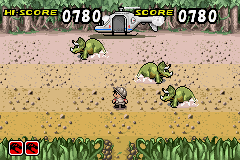
That's where the interest stops, though, as the game itself is about what you'd expect from some cheap knocked-out crap sold in a tourist attraction gift shop. It's a collection of mini-games, which aren't even original, just Jurassic Park-themed knock offs of existing games. There's Cross Dinosaur, which is just Frogger, except you're a little safari man running across a valley while trying not to get trampled by triceratops. Next is Danger Zone, which has you playing as a parasaurolophus who has to repeatedly get from the left side of the screen to the right side of the screen while avoiding volcanic rocks falling from the 'bove.


Egg Guard is the old Game and Watch game Egg, except there's six channels instead of four, and it's a lot slower. It's themed as you being a pteranodon sat in your nest at the centre of the screen protecting your eggs from poachers who come slowly walking down the six channels. I actually had to lose all my lives on purpose in this game, since even when they get to your nest, the poachers will just stand there for several seconds before taking an egg. Rexcercise is another Game and Watch game, this time being Flagman, one of the worst G&W games, which isn't made any better by the presence of a T-Rex.


The final game is Take Meat, which is a slightly more complex and interesting version of Danger Zone (relatively speaking). You now go back and forth across the screen instead of repeatedly going from left to right, and when you're at the right edge of the screen, you can pick up multiple pieces of meat before returning, which gets you more points while slowing down your movement. Also, you're know avoiding mortars being fire by a little man atop a nearby cliff instead of volcanic rocks. There's also a gallery mode, where high scores are rewarded by tiny, very low resolution screenshots from the first three Jurassic Park movies.


The curiosity is all this game has going for it, really. It's not worth your time, and the unusualy circumstances of its release mean that it's definitely not worth the ridiculous prices a real copy fetches online, either. The Game Boy Color and Advance are two systems reknowned for low quality licensed games, and Jurassic Park Institute Tour: Dinosaur Rescue lives up to that stereotype every step of the way.

Wednesday, 9 December 2020

Dokapon - Monster Hunter (GBA)


 You look at this game's logo, and the western boxart, and it's easy enough to tell that it owes its western release to a superficial resemblence to the Pokemon games. Though there is a monster recruiting mechanic in Dokapon, it's entirely optional, and the items needed to do it are pretty rare. Personally, I didn't bother with it at all, but the game has enough of its own charm and ideas that it doesn't need to be a Pokemon mockbuster.


I'll address the most obvious quality first: the way the game looks. Though there's not much in the way of animation, the spritework in the game is beautiful. The overworld sprites look as if someone took the typical blobby pre-rendered sprites seen in so many GBA games and drew over them to make them look good, but the in-battle sprites are the jewel in the game's visual crown. Every enemy monster is a very charming, well drawn creature or humanoid, and your own character's sprite is not only their equal in terms of being well drawn, but there's a unique sprite for every sword and shield you can obtain in-game. That's two hundred all together!


The dungeons aren't particularly interesting. There's a slight bit of roguelike-ness, with procedurally generated floor layouts, but the battles are all more traditional RPG turn-based battles, and you don't recover health while you walk around, nor is there a hunger mechanic. You also get to keep your level when you die, but not your items, equipment, or money. The equipment is the biggest loss, to be honest, as it levels up as you use it, so a sword and shield that have lasted at least one dungeon are going to be significantly stronger than anything on sale in the town shop. I've played up to the third boss so far, and I do like the game enough that I'll probably play it all the way through eventually, and I do like that after the first two dungeons taking the standard settings of mine and forest, the third takes place in a circus.


Another misconception you might have on your first play is that the battles are simple and boring, but there are in fact quite a few interesting ideas in there! First, there are attack and defence turnsl when you attack, your enemy defends, and vice versa. The reason this is interesting is because of the second big idea: rock/paper/scissors. Whether attacking or defending, you can either choose the standard attack or block, or one of three skills, each mapped to rock, paper, or scissors. Your enemies do the same. If, while defending, you pick (for example) your "rock" defence skill, and your enemy attacks with their scissors attack skill, their attack is totally nullified, and you get the effects of your defence skill. Defence skills are usually stat buffs or status recovery, attack skills might do more damage, or inflict status ailments, and so on.


You might have read the previous paragraph and think that this means that the battles are a totally luck-based affair, but that's really not the case at all. You can see what attack skills your enemies have equipped to each slot, and with this knowledge, you can make an educated guess as to what they'll do. Certain enemies will prefer to try and inflict certain status ailments, for example. Or, you might see a fire-breathing enemy that has a skill named "napalm", and you just use common sense to assume that they'll try and use that when they attack. It's actually a fun and interesting system, that brings a little more strategy to random battles against non-boss enemies that, in a lot of other RPGs, would just have you mashing the confirm button to attack until the battle's over.


If you like RPGs, Dokapon Monster Hunter has a lot to offer in most departments except plot (which is barely present at all, and what little there is is very cliched). If you don't, it probably won't do much to convert you. On the other hand, if you like pixel art, you should at least go and look up sprite sheets for the enemies and equipment because they're really, really good. It's good enough that it's also got me curious about other entries in the series, so expect some of those to pop up on the blog at some point in the future, maybe.

Saturday, 22 August 2020

Fantastic Children (GBA)

 On paper, Fantastic Children should be worthless shovelware garbage. It is, after all, a licensed GBA platformer based on an anime. I can't tell you much about the anime other than that it's apparently about a group of immortal 12 year olds, and it was created by Takashi Nakamura, whos distinctive character design style you're sure to recognise if you've seen the movie Catnapped. It does have an official english release though, and I might just give it a watch someday, as if the game really gives me vibes of those classic kids adventure anime from the 80s and early 90s, like Giant Gorg, Mysterious Cities of Gold, and The Secret of Blue Water.


Right from the start, it's obvious that this game is possibly the best-looking game on the system, with lavish, detailed backgrounds, and really amazing animation on the main character's sprite. As he runs, jumps, climbs, falls, and so on, you can really feels the weight of his body and the force of his movements, and those are all things you do a lot of, since most of the game is made up of Prince of Persia-style precision platforming. It's so far beyond the usual garish colours and blobby pre-rendered sprite you see all too often on the GBA.  


Like I said, the game is mostly PoP-style platforming, as you clamber around, exploring various environments, like jungles, abandoned buildings, quiet little seaside towns, and so on. The quality of the animation makes this a totally joyful experience, even if he practice of holding the jump button to grab and keep ahold of ledges, then pressing up to climb onto them takes a little bit of getting used to at first. What's  really unique about this game is the rare occasions when you meet enemies (well, there are wild animals that can hurt you right from the start, but they're more like hazards than enemies), as this is the only platform game that I can think of that has turn-based combat!


The way it works is that you and your opponent each has a hand of five attacks. There are specials that each do specific things, but mostly, you'll be using punches, kicks, and chops, which have a rock-paper-scissors dynamic going on: punches beat kicks, kicks beat chops, and chops beat punches. You can switch between your attacks as much as you like in the few seconds before they meet in the middle, at which point one of you takes damage (or both if you each used the same attack). Used attacks are discarded, and if the fight's still ongoing after five turns, you each get your full hands back and carry on. 


You can change the attacks in your hand via the pause menu, and you get more choices, including things like attacks that hit twice when they win, as well as the aforementioned specials, by beating enemies and opening treasure boxes. Certain kinds of enemies have specific hands too, so if you know you're going into an area where the enemies prefer kicks, you might want to build a punch-based hand, for example. It's a system more interesting than exciting, but it does solve the problem of having enemies without them getting in the way of the sheer kinetic joy of the platforming.


I think that's all I really have to say about Fantastic Children. Of course, I very highly recommend that you go and play it as soon as possible, and don't worry about there being a language barrier, as while the story text is all in Japanese, all the menus and so on are in English. It should be counted alongside Ninja Cop, Gunstar Super Heroes, and all the other truly great GBA games that people still love to this day, it's honestly that good.

Thursday, 16 July 2020

L'Aigle de Guerre (GBA)

The Game Boy Advance being a big step up in power from the handhelds that had preceded it meant there were various attempts at genres that were previously impossible on handhelds. Like how there are a whole bunch of GBA first person shooters, for example (I know the original Game Boy had Faceball 2000, but that's a far cry from a port of Doom). L'Aigle de Guerre is an attempt at squeezing a real time strategy game onto portable hardware,and a fairly successful one at that.

Well, it's successful at being an enjoyable game, at least. I suspect that fans of super fast-paced multitasking PC real time strategy games will probably be left a little cold. It is a lot slower paced, which is at least partially down to the fact that instead of a cursor, you control Napoleon, as you ride around the battlefield, telling your soldiers where they should go in person. Other than that, the game mostly focusses on capturing bases by sending infantrymen, the weakest units into them.

Infantrymen are the weakest, but you need to send four into an enemy base (or a neutral city) to capture it, cavalry are faster and more powerful, and artillery are the most powerful, but they move very very slowly. On some stages, you'll also get various kinds of boats, but they're pretty much just nautical versions of your land units. Like I said, most stages will have a main enemy base to capture, but some of them are boss fights, like a giant monster troll thing, or Horatio Nelson surrounded by giant cannons and endlessly respawning soldiers.

The plot is something that's definitely worth talking about in this case, as all of the characters seem to be people who actually existed, with the main villain being the strangest of all: wax museum proprietress Marie Tussaud, depicted ingame as being an evil monster-summoning witch who wants to take over the world. Only Napoleon and his plucky band of French military commanders can stop her!

L'Aigle de Guerre is a pretty fun game, and I definitely recommend that you give it a try. Like I said earlier, though, don't go in expecting something like Starcraft or even Command and Conquer. It's its own thing!