Showing posts with label kusoge. Show all posts

Sunday, 30 November 2025

Building Crush! (Playstation)


 This is a hard post to write, and one I really hoped I wouldn't have to. The reason it's a hard post to write is because Building Crush! is an awful game, and everytime I loaded it up, I dreaded actually playing it. The reason I hoped that I wouldn't have to write it is because I'd originally planned to write about a differrent Playstation game, Buckle Up. Buckle Up is a pretty interesting semi-open world driving game that I think is kind of inspired by Dukes of Hazzard? But unfortunately, I couldn't figure out how to get past the first mission, so here's Building Crush! instead.


Building Crush! is a colour-matching puzzle game themed around the idea of competitive building demolition (or crushing, if you will). You and your opponent each stand on a window-washer's platform in front of a tall building. The buildings are made of cubes in various colours, most with windows on them. The windows are constantly opening and closing, and you have to throw bombs into them when they're open, then detonate them. When you destroy a cube in this way, any cubes touching it that are the same colour will also explode. Furthermore, the cubes above will fall down, and if they do so in a manner that creates a formation of four or more touching cubes of the same colour, those formations will then explode, creating the traditional competitive puzzle game chain reactions. 


So far it doesn't sound too bad, right? The main problem is that the game is incredibly slow. Moving around is slow and throwing the bombs is slow (and made worse when a window closes and your bomb just falls down uselessly). The only way to win a round is to destroy every last cube of which your building is composed, so rounds take several long minutes to finish, and each stage is a best-of-three match. Making things worse is that some cubes don't have windows, and can only be destroy either by linking them to same-coloured ones that do, or by repeatedly (and slowly) hitting them with many bombs until they eventually crack and disappear. And no matter how well you plan things, you'll always end up with at least one of these at the end of a round.


Another complication comes in the form of random objects that sometimes fall down from the 'bove. If they hit you, they actually slow things down in two ways! First, you're momentarily stunned. Then, a witch will fly onscreen and change one of the windowed cubes onscreen into an unwindowed cube. It's all a shame, as I'm sure the basic concept of the game could have been fun. It needed to be a lot faster, louder and more manic, and maybe have a lot bigger explosions and maybe some numbers flying around the place when you score big chains. As it is, it really feels like the developers were anxious about possibly over-stimulating players or something, like they might have had a good idea once, but stripped away all the fun and excitement, chasing some theoretical puzzle game player that won't play anything that isn't sedate. That's all conjecture on my part, of course. I doubt there's ever been or will ever be a developer interview related to a low budget Japan-only console-exclusive puzzle game from 1996.


Obviously, I don't recommend Building Crush! That exclamation mark at the end of its name is the most exciting thing about it. I guess it's also worth mentioning that your character has a little animated facepic thing that appears (and blocks your view) when you're doing well, and you actually make the face using a little photofit-type thing before you play. That's mildly impressive. Also one of the stage backgrounds is a photo of some people (presumably the developers) having a nice time in a nightclub, which is the kind of thing you don't really see in commercial videogames anymore.

Saturday, 25 March 2023

Hit Back (Playstation)


 Hit Back (which seems to be listed on some piracy sites as "3D Bouncing Ball", "3D Bouncing Ball Puzzle" and maybe also "Ball Mayhem") is a great example of a game with a simple and obvious concept, that asks the question "why hadn't anyone done this earlier?", and then through playing it, you quickly find out why. The concept is "Arkanoid in 3D", as the game sees you standing at one end of a corridor hitting a ball in the hopes of hitting all the blocks (in trial mode) or enemies (in story mode), without letting the ball go past you.


To be fair though, the game has a few problems, and only one of them is conceptual. If you think about it for a while, you'll probably figure it out, but: the worst part of an Arkanoid-like is the part at the end of each stage where you're stuck watch the ball tediously bounce up and down the screen until you can get it to hit the final block so you can move on. That problem becomes so much worse when there's not only a third dimension for the ball to rattle around in, but also when the "blocks" are moving enemies, who can also move around in three dimensions! You're left feeling the cells in your body die one by one as you see the ball and your last target pass each other by like ships in the night for the fiftieth time in a row. So, at a conceptual level, the game doesn't really work very well. It gets worse, though!


The above is also exacerbated by various technical problems the game has, each of which contributes to making it even less fun to play! I'll start with the collision detection. It's just bad. Part of it lies in the hitboxes just making no sense at all, as the ball will hit enemies that it wasn't even close to actually touching, while passing harmlessly through others. Part of it must be the result of something strange going on under the hood, though, especially with regards to the player characters' interactions with the ball. Sometimes, if your character is close enough to the ball, they'll reach out an arm to hit it, and that's fine. Sometimes, they won't do that. Sometimes, the ball hitting your character's torso counts as hitting it back into the field, and sometimes it doesn't. Most frustrating of all is the vertical element. Sometimes the ball goes over your head, and you have to jump to hit it. But sometimes you don't have to jump to hit it. Furthermore, sometimes, jumping will specifically miss the ball. There's no consistent rule as to how high the ball has to be for any of these conditions, they all just seem to happen at random.


Obviously, I don't recommend seeking this game out at all. If it worked properly, it'd be mind-numbingly boring, and as it is, it's a pointless, playable exercise in hoping the code likes you each time the ball comes back. The character designs are weird and cute, though, and some of the music is okay.

Sunday, 17 October 2021

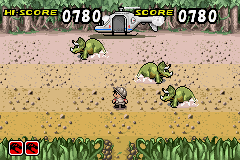
Jurassic Park Institute Tour: Dinosaur Rescue (GBA)


 This is a notable game for a few reasons. Firstly, it was developed by KaZe, a company known for their excellent Saturn pinball games Last Gladiators and Necronomicon, and their more experimental pinball games  Power Rangers Zeo Full Tilt Battle Pinball on Playstation, and Akira Psycho Ball on PS2. Secondly, it's a Japan-only release based on a western property, which is mildly interesting itself, but on top of that, it seems to have only been available to buy in one place: the gift shop at Jurassic Park Institute Tour, an edicational interactive museum exhibit thing.


That's where the interest stops, though, as the game itself is about what you'd expect from some cheap knocked-out crap sold in a tourist attraction gift shop. It's a collection of mini-games, which aren't even original, just Jurassic Park-themed knock offs of existing games. There's Cross Dinosaur, which is just Frogger, except you're a little safari man running across a valley while trying not to get trampled by triceratops. Next is Danger Zone, which has you playing as a parasaurolophus who has to repeatedly get from the left side of the screen to the right side of the screen while avoiding volcanic rocks falling from the 'bove.


Egg Guard is the old Game and Watch game Egg, except there's six channels instead of four, and it's a lot slower. It's themed as you being a pteranodon sat in your nest at the centre of the screen protecting your eggs from poachers who come slowly walking down the six channels. I actually had to lose all my lives on purpose in this game, since even when they get to your nest, the poachers will just stand there for several seconds before taking an egg. Rexcercise is another Game and Watch game, this time being Flagman, one of the worst G&W games, which isn't made any better by the presence of a T-Rex.


The final game is Take Meat, which is a slightly more complex and interesting version of Danger Zone (relatively speaking). You now go back and forth across the screen instead of repeatedly going from left to right, and when you're at the right edge of the screen, you can pick up multiple pieces of meat before returning, which gets you more points while slowing down your movement. Also, you're know avoiding mortars being fire by a little man atop a nearby cliff instead of volcanic rocks. There's also a gallery mode, where high scores are rewarded by tiny, very low resolution screenshots from the first three Jurassic Park movies.


The curiosity is all this game has going for it, really. It's not worth your time, and the unusualy circumstances of its release mean that it's definitely not worth the ridiculous prices a real copy fetches online, either. The Game Boy Color and Advance are two systems reknowned for low quality licensed games, and Jurassic Park Institute Tour: Dinosaur Rescue lives up to that stereotype every step of the way.

Friday, 25 June 2021

Super Bikkuriman (SNES)


 A few years ago, I reviewed a platform game for the Game Boy based on this same property, and it wasn't great. But because the character designs are interesting enough to capture my interest, and because old licensed fighting games are also interesting to me, I decided to look at this SNES adaptation. Unfortunately, it's even worse. A lot worse.


In single player, it takes the old pre-Street Fighter II approach of having only two playable characters facing off against a bunch of CPU opponents in a set order, though all the characters can be played in versus mode. It's also like a pre-Street Fighter II game in that you don't get any special moves. All you get is punch and kick, a slightly stronger punch and kick executed by pressing forward at the same time as the button, and a flying kick that only works sometimes. I have no problem with simple fighting, I've recently been getting obsessed with Psikyo's arcade-only martial arts fighting game Battle K-Road, which doesn't have much in the way of moves, and half its roster are headswaps of the other half, but this is an incredibly barren effort.


It doesn't even look good! In still screenshots, it looks like it might have fit in among fanmade X68000 games from a couple of years earlier, while in motion, it looks even worse! The characters have barely animation, and when you look at other games coming out on the SNES and Mega Drive in 1993, it stands out even more. It's a shame, since, like the Game Boy Super Bikkuriman game, the box and label art are pretty nice, and probably suckered in some unfortunate victims back when these games were first released.


As I played this game more, and as I was thinking about writing this review, it gradually dawned upon me the best possible way of describing it succinctly: it's anime Rise of the Robots. The terrible animation, the lack of playable characters, and the complete absence of any fun or excitement, but this time you've got knights with very long hair fighting various monsters, instead of a blue ugly robot fighting different coloured ugly robots. Just like Rise of the Robots, though, Super Bikkuriman is a game that's not worth playing at all. It's not even bad in a funny way, it's just boring.

Thursday, 23 July 2020

Taiyou no Yuusha Fighbird GB (Game Boy)

So, I was attracted to this game due to it being a vertically-scrolling shooting game on the Game Boy, which is pretty unusual. The Game Boy does have some surprisingly great shooters, of course, but they tend to scroll horizontally, like Nemesis II, for example. It's also interesting because instead of a ship flying up the screen, you're piloting a giant robot, walking up the screen.

Unfortunately, it doesn't do a very good job of representing vertical shooting games on the Game Boy, on account of it being rubbish. The problem is not just that it's easy, but it's also boring. You trudge up the stages, easily killing the occasional enemies (that mostly don't even really look like anything besides abstract shapes). You can take eight hits before getting a game over, but after you've taken one or two, you can rely on a nice convenient power-up to come along and restore you back to full health.

As a result, I completed Taiyou no Yuusha Fighbird the first time I played it. Then I completed it again to take screenshots for this review. The thing is, before you start playing, there's a character select screen, with two characters to pick from, and the title "select your level". Whichever you pick, there doesn't appear to be no difference at all, either in the character you're controlling or in the difficulty of the stages. Mysterious. Either way, the game's about ten minutes long, and they aren't even ten particularly exciting minutes.

I don't recommend wasting any time on this game, unless you really need to play every Game Boy shooting game, or if you're completely obsessed with the anime on which its based and need to experience everything to do with it. Otherwise, don't bother.

Thursday, 5 March 2020

The Fighting Wolf AT (MSX)

For such an early entry into the belt scrolling beat em up genre, and from a relatively small company like Technopolis Soft, it's impressive how versatile the controls in The Fighting Wolf AT are. With only a D-pad and two buttons, you can walk in eight directions, punch, kick, and even duck and jump! Unfortunately, you only ever have to walk left, walk right, and punch, and in fact, doing anything else will diminish your chances of survival.

So, each stage consists of a few screen's worth of a repeating background, though it doesn't matter if you walk to the end or not, only that you defeat every enemy. Although it would be more accurate to say that rather than "beating every enemy", you're beating enemies until they eventually stop spawning. Each stage has exactly two kinds of enemy: one that spawns on the right of the screen, and one that spawns on the left of the screen. Beat one, and an identical one will take its place. Keep doing this and after a couple of minutes, you've beaten the stage.

I don't know how long the game is, but the technique that got me to stage five (the enemies do gradually become more enthusastic about trying to fight back, and you only get one life) is just to repeatedly punch one enemy until it's dead, then turn around and punch the enemy on the other side until they're dead. By then, the enemy on the first side will have respawned and walked up to you, so repeat the process. And that's pretty much the entire game. The background changes each stage, as do the sprites for the enemies, but they all play the same.

There's not much more to say about this game. It looks okay, except when the screen scrolls, and the music isn't terrible I guess. The best thing I can say about it is that the enemies in th second stage are a woman and a baby, which is kind of odd. Don't play The Fighting Wolf AT, it's rubbish.

Sunday, 1 December 2019

Logic Pro 2 (Arcade)

So, I've already reviewed the first and last parts of this trilogy in the past, and I've finally decided to write about the awkward middle child, which also happens to be the black sheep of the family. While Logic Pro and Logic Pro Adventure are the best nonogram games I've ever played, Logic Pro 2 rivals Oekaki Pizzle for the title of worst.

Where Oekaki Puzzle was boring and joyless in its execution, Logic Pro 2 is actively hateful. The big problem it has is that in attempting liven up their sequel, the developers thought it would be a good idea to add enemies into the mix. Now, this isn't some kind of versus mode where you race to finich a puzzle before an AI opponent, it's little creatures crawling around the grid doing stuff while you try to solve the puzzle. That "stuff" being erasing the crosses you use to mark squares that definitely don't need filling in, or adding crosses of their own, or just sitting and getting in the way.

You can kill all of the aforementioned enemies, though they respawn a short time later. Another type of enemy is unkillable, though, as it appears outside of the grid: the caterpillars that wiggle onto the screen now and then to cover up the numbers. You already have a time limit, and now you'll be wasting valuable seconds waiting for these jerks to wiggle away again so you can actually see the puzzle you're meant to be solving!

The real shame is that other than the enemies, it's mostly the same as Logic Pro Adventure: great graphics, decent puzzles, and that weird gimmick where you collect fifty little dots for a big bonus. It's just ruined by the enemies. I guess Adventure does prove that they learned from their mistakes though, which is nice. Still, don't play this game, no matter how much you're left wanting more after finishing its stablemates.

Sunday, 15 September 2019

Oekaki Puzzle (Neo Geo Pocket Colour)

Long time readers might remember that I've always said that Logic Pro (and its sequel, Logic Pro Adventure) are by far the best nonogram videogames around, with all others being mediocre by comparision. Well, it's time for some exciting news: I may have found the all-time worst example of a nonogram game in Oekaki Puzzle!

To start with, it has the same big flaw as so many others: non-existant stakes caused by a lack of any real lose condition, with the added caveat that you get zero feedback at all on whether you're marking the right or wrong squares. It's also missing some common quality of life features, like highlighting the row and column your cursor is currently on so you tell where you are at a glance, for example.

Then there's the puzzles themselves, which are completely joyless things to solve. I think there's three main reasons for this. One: a lot of the puzzles turn out to be things like letters or numbers or just simple shapes when you complete them. Two: a huge amount of the puzzles are symmetrical, so when you've solved half the puzzle, you just go and do the same thing reversed on the other half of the grid. There's a soul-crushingly long series of near-identical animal faces that are all particularly egregious offenders in this department. Three: a lot of puzzles also feature a lot of rows where the numbers have a lot of ones and twos. This is a hard one to explain, but it makes the puzzles really tedious to solve, and also removes the mild satisfaction of filling in a long line of squares with reckless abandon.

I've actually gone back to the original Logic Pro recently, attempting to finish it in a single credit like I did with Logic Pro Adventure when I reviewed it last year, and the differences between that game and Oekaki Puzzle really show how such a simple concept can be executed by two games with such a vast chasm of quality between the two. Don't bother playing this game.

Saturday, 10 August 2019

Gamera - Daikaijuu Kuuchuu Kessen (Game Boy)

Videogames based on Kaiju and Tokusatsu properties can be a mixed bag, though I'm probably not alone in thinking that the 2014 Godzilla game on PS4 is probably the best. And while its true that a lot of these games have got a worse rap than they deserve due to critics not really understanding their appeal (the common opinion of the Dreamcast's Godzilla Generations, for example), I might have found the worst of them all, by some considerable margin.

How Gamera - Daikaijuu Kuuchuu Kessen works is kind of like a turn-based fighting game, with no menus. Every turn, you're asked to input a command, then both monsters' maneuvers play out, and that carries on until one of them runs out of health. The closest thing to which I can compare it is probably the weird FMV fighting game Battle Heat on PC-FX. Except it's on the Game Boy, so you don't even have the visual spectacle of lavish full-screen animation to liven things up. Though if you're playing on a Super Game Boy, there are some nice borders to look at, I guess.

There are really two problems with this game, and they're both massive ones. The first is the inconsistency: it seems like pressing the same button combination on different turns doesn't always result in the same action, and furthermore, performing the same action won't always produce the same results, even if the enemy does the same thing, too. So the game boils down to you watching little animations of Gamera and his current opponent doing seemingly random things at each other until one of them suddenly gets hurt. This repeats over and over until one of them runs out of health, and to make things worse, you have to win two rounds against each monster.

And that leads nicely into the second problem: this game is unbelievably slow! Honestly, it took me a few attempts to get past the first fight, simply because it was sapping me of the will to live, and when I did finally get past it, it took over twenty minutes! And that's without losing any rounds! Then you get to the next stage and are faced with the prospect of this carrying on. Apparently this game has a total of five stages, but I can't imagine anyone having the patience to play through them all. I definitely don't recommend trying to.

Wednesday, 3 July 2019

Supreme Warrior Ying Heung (Mega CD)

I've long theorised that the thing that killed the Mega CD was western publishers and their obsession with FMV, since the PC Engine CD, which had almost no support in the west, and had no FMV games, was a pretty big success (in Japan, at least), just by having lots of good games. Until now, though, I hadn't actually played any of the western "interactive movie" style FMV games, only the likes of Road Avenger and Strahl: the "laserdisc arcade" school of FMV games that were made up of long strings of QTEs and cool-looking 80s animation. Those games are pretty fun, if very limited.

Supreme Warrior Ying Heung is the first interactive movie I've played, and using the word "played" is an act of generosity it doesn't deserve. The story sees an evil warlord attacking a small town in sixteenth century China, demanding half of a magic mask from the local martial arts master. If he gets the mask, he'll be all-powerful and go on to rule the world. Unfortunately, the master is too old to fight the warlord, and his best student is injured. So it falls to you, a collection of disembodied limbs attatched to a movie camera to save the day.

There's some good things about this game, that I should mention before I continue with its burial, so here they are: the production values are surprisingly good, in a mid-90s American TV show kind of way, and the video quality is a lot better than most live action Mega CD games. That's about it, though. The big problem is that the developers have tried to make something a bit more sophisticated than the typical QTE festival, and it just doesn't work. This is a problem shared by one of the aforementioned laserdisc arcade games, Cobra Command (aka Thunderstorm FX), which added a fiddly, semi-functional crosshair shooting element to proceedings. Supreme Warrior manages to be go even further with the complexity, and while Cobra Command was pretty difficult to play, this game is practically impossible.

The actual game part of Supreme Warrior has you fighting the warlord's three henchmen, then, if you somehow manage to beat them, the man himself. The fights are completely live action and first person, with the henchmen punching and kicking in the direction of the camera, while you're expected to punch, kick, and block in accordance with the little prompts that appear at the edges of the screen. The problem is that the prompts sometimes don't appear, and sometimes hitting the right direction and button doesn't do anything. I made a few attempts at fighting each henchman, and I never landed more than two hits on any of them. It just doesn't work on any level: it's no fun to play, the basic mechanics don't work, and your hands and feet flying in from the edge of the screen look stupid every time.

I wish I could say it was a shame that this game turned out how it did, and that the concept had so much potential, but I can't see how else they would have done it. I guess they could have made it a simple QTE game like the arcade games that had been originally released almost a decade earlier, or they could have used the movie segments as mere cutscenes to a more traditional action game, maybe with Mortal Kombat-style digitised sprites. But neither of those solutions really offers the kind of interactive movie innovation towards which Digital Pictures strove. Since no-one else has managed to make a good game from the concept in the decades since, maybe it's just not possible?

Monday, 27 May 2019

Plus Plum (Dreamcast)

Also sometimes spelt as "Plus Plumb", this is a pretty low budget-looking, Japan-only competitive puzzle game. Of course, it's about matching coloured blobs, but it does at least bring some new ideas to the table, even if they're not good ones.

Like you might expect, Plus Plum has you arranging coloured blobs into matching sets of three, which then disappear. What's different is what happens when they disappear: not only do the blobs above them fall down, but all the blobs touching them also change colour. So to make combos, you not only have to take into account where the blobs will fall, but what colour they'll be when they do. Luckily, the colour changing isn't random, and the six colours are in three pairs: red and blue, white and purple, and yellow and green. The blobs also only fall one at a time, and rather than changing shape or formation like you would in most puzzle games, you can move that one blob around, and change it to its opposite colour.

It takes a bit of getting used to, but it's pretty simple once you've got the hang of it. I think with a bit more work, it might have led to a decent puzzler, but this game has one massive problem: it's incredibly slow. I haven't had a single game, win or lose, that's taken less than four minutes. The blame for this falls at the feet of PP's other oddball mechanic: the playing fields of you and your opponent are on some kind of counter-balanced platforms, and the game is lost when either one player's platform has been lifted high enough that their blobs touch the top of the screen, or their platform is so weighed down that it hits the bottom. Compare these four minute matches with the likes of Magical Drop (my personal favourite competitive puzzle series), where matches can be won or lost within seconds of them starting, and Plus Plum feels like a meandering, tension-free bore.

I can't recommend tracking down Plus Plum at all. There might not be as many competitive puzzle games on the Dreamcast compared to the Playstation, but there's still plenty that are better than this one. Strangely, though, it was apparently popular enough to get a sequel, Plus Plum 2. However, that was released on the original XBox, in Japan only, so it presumably sold about seven copies.

Friday, 4 January 2019

Sword of Sodan (Mega Drive)

This is a game whose title I'd always seen in lists of Mega Drive games and never bothered to take any notice of, assuming it was some boring, ugly western-developed RPG or something. Then I learned that in 1995, the final issue of Beep! Mega Drive magazine had it listed as the lowest rank Mega Drive game of all time, by Japanese Mega Drive owners. The fact that a western-developed game had gone pretty much entirely unnoticed in the west, while enjoying such notoriety in Japan got my interest, so I investigated. Turns out it's not an RPG at all, but an ugly, boring single plane beat em up!

You start out picking from a nameless hero or heroine, and then you set out to awkwardly shuffle forwards, swinging your sword at everyone that crosses you path. The game was apparently originally released on the Amiga, though since it uses all three buttons on the Mega Drive pad, plus the start button, it must have been even worse on a system whose controllers had one or maybe two buttons available at best. Anyway, the C button attacks (and you also have to press it in conjunction with the d-pad if you want to change the direction you're facing), B does a little jump that's totally pointless until a few stages in, when you can use it to try and jump over the massive, invisible instant death pits, and the A button drinks potions.

The potions are probably the most interesting thing about Sword of Sodan. There's four different potions to collect, and you can carry up to four at a time. The twist is that when the game is paused, you can pick two of the potions in your inventory to mix together for various different effects, from extra lives, to flaming attacks, to pointless self-poisoning. Otherwise, though, you mostly just shuffle along, hacking at enemies, and hoping you don't get torn apart by the traps in the stages, which are near-impossible to dodge with your incredibly unathletic warriors. Another little point of interest is that some enemies do require a little extra technique to kill, for example, the giants that start to appear at the end of the third stage: press C and up to slash their faces until they take a knee, then you have to stand at he exact right distance to them, and press C and up a couple more times to behead them.

I don't think Sword of Sodan is the worst Mega Drive game of all time, but it is a very bad game, and it's not one you should waste any time playing. It's not really a surprise, but that's how it is sometimes.