Showing posts with label beat em up. Show all posts

Saturday, 31 January 2026

Gaiapolis (NES)


 This is an unlicensed port of the arcade game of the same game. Double unlicensed, even, since they didn't ask Nintendo if they could make a Famicom game, nor did they get permission from Konami to make a port of their arcade game. Still, this is the game to show people when they, in their ignorance, parrot lazy old stereotypes about unlicensed Famicom games being low quality, as when it came out (circa 1994-95, according to people who probably know, like those to maintain the Bootleg Games Wiki), it might well have been the best beat em up on the console.


But before I get onto that, I should probably describe the arcade game for those who don't know it, and also address the inevitable differences that are going to happen in porting an arcade game to vastly underpowered hardware. The arcade Gaiapolis is a vertically-scrolling, top-down beat em up with a fantasy theme and even a little bit of RPG nonsense. The RPG stuff comes in the form of not only experience points and level ups, but also in passwords used to carry those over into future games (something Capcom would later also do in their single player-focused fighting game Red Earth/Warzard). You also get little buddies following you round to help fight enemies. A little robot knight or a little armadillo thing, etc.


This version is also a top-down vertically scrolling beat em up, and it does a pretty impressive job of replicating the game at this basic level. It includes all three playable characters from the original, has a simultaneous two-player mode and manages to put you up against several enemies at a time, all feats that even some SNES beat em ups famously couldn't manage. The levelling up is also present, though there's no passwords to carry it between games (and since you always fight the same enemies and get the same items, this means you always level up at the exact same rate). The little buddies are also gone, which is understandable, but still a little sad.


On its own terms, without compared it to the original, Gaiapolis is a good game. It looks amazing, there are very few Famicom games that can boast of such detailed backgrounds (there's some really impressive animated rivers and stuff that look amazing!), or of throwing around so many big characters around the screen all at once. There's a few points where a discerning eye can see the metaphorical strings (one big example is that your screen-clearing magic attack and the large sprites used for certain bosses are both made of background tiles, so they can only appear on alternating frames), but honestly, that kind of thing only makes it all more charming. And most importantly, it's fun to play, too.


Obviously, you can probably play the arcade version in 2026 just as easily as you can this one. Maybe even easier! Which does make this version a little obsolete from a totally objective standpoint, but I think it does still have some value. It's a fun game, even though it's so heavily compromised, truncated, and abridged, and more importantly: it's interesting. It's so far beyond most (maybe all) of the officially released Famicom beat em ups, and it really shows that the people at Sachen really had a handle on how to get the most out of the system, which was a decade old when this game was released. If you are interested in developers drawing miracles from ancient hardware, it's definitely worth your time.

Saturday, 13 December 2025

Bad Boy Brother (Switch)


 This game has another title, and once you know it, you'll also know why I was so excited to pre-order it as soon as I knew it existed: Simple Series for Switch vol. 5: Yankii Bros! The Simple series is back (and has been for four previous entries)! With a beat em up about juvenile delinquents! It's almost like they made this game specifically because they knew I was finally going to get a Switch this year or something.


It's not just in name only, either, as this is a game that really does keep the Simple spirit alive, for all the good and bad that implies. It's a game with several (too many?) ideas that all tie together well thematically that was also clearly a passion project for its creators. Also, it's got a whole bunch of randomness and grinding, and a ton of stuff to unlock, including both stat upgrades and new special moves. Luckily, the good outweighs the bad. And also: videogames are a creative medium, and most of the things we consider good practice are "rules" rather than "laws". (Of course there are some exceptions: real money shops and gambling are always indefensible and to a game's detriment, as are the dark patterns present in almost every modern phone game. I can't imagine there ever being exceptions there.)


What the game is is a beat em up, that uses a vague roguelike structure to facilitate some traditional Simple asset reuse and playtime extension. Each stage has five segments, the first four of which will see you fighting many enemies. They'll either give you a quota of enemies to beat, or an amount of time you have to survive/beat as many enemies as you can. The fifth segment will always be a boss fight, though the bosses are randomly chosen from a small pool for each stage. Before each stage, you'll be dealt a hand of twelve mahjongg tiles, which correspond to various stat and ability uprades. The upgrades increase exponentially when you get matching tiles, and even more if you're able to form scoring hands with them. After each segment, you're given a chance to swap out tiles from your hand with a random selection of four. After you complete a whole stage, you keep all the tile and hand-based upgrades you had at the end of it, then get dealt a whole new hand to get further upgrades.


Furthermore, there are aliases. Theses are made at random when you score triple sevens on the roulette at the top of the screen, which turns when you fill up a meter by hitting enemies a lot. They're made at random from words that enemies "drop" (also at random) as you're fighting them. They're always made up of an adjective half that determines their effect, and a noun half that applies a multiplier to the effect. Also they're always nonsense like "Jobless Chihuahua" or "House-Moving Sinbad", because of the multiple layers of randomness involved in their formation. There's also a shop to access between runs, where you use coins earned by defeating lots of enemies to buy more advantageous tiles to add to the pool, special moves performed by bosses you've beaten, and more.


Like I said, there are exceptions to many "rules" of what makes a good game, and while I usually hate randomness and upgrades in action games, Bad Boy Brother feels good enough that I can easily overlook them here. It's also admirably committed to its setting. You might expect a budget game that happens to include an English translation to be dry and functional, but all the text, even stuff like the game telling you it's loading or saving your savefile is written "in character", with a little cartoony tough guy edge to it. The most insane (and probably most expensive) bit of flavour is that there's a constant expository rap going on as you play, too. It's always in Japanese, and you'll be too busy playing the game to read the subtitles, but they are there, and it's just another sign of the commitment and passion the developers had for this game.


You've probably figured it out by now, but I really like this game, and I enthusiastically recommend it. It's just a ton of fun to play! It's got a worldwide release as a download, but even if you import a cartridge copy from Japan, it includes English and Chinese language options. Not only is it a good game, but it also gives me hope that the Simple series is truly back, and in the hands of people who are willing to keep up its silly, fun, experimental tradition.

Friday, 1 August 2025

Guardians (Arcade)


Also known as Denjin Makai II, this is a game that I'm not totally sure about including. It's very well known among arcade fans, but conversely, it's almost totally unknown to everyone else. There's some reasons for this, like it being a beat em up that came out just a year or two after that genre's original heyday was on the wane. Plus it's in at that level of technology where it was way too advanced for a port to the Mega Drive or SNES (in fact, the game to which it's a sequel got a SNES port for which a lot of compromises had to made, so this one had no chance), but a lot of people would have ignorantly stuck their noses up in the air at a port to Saturn or Playstation.


It's a massive shame too, as it might well be the best beat em up from before the recent genre renaissance. You constantly have a whole bunch of attack options, and it offers superior solutions to some long-standing problems the genre had back then. There's a whole bunch of characters to choose from, all of whom are wildly different in design: there's a ninja and a kung fu guy, a big triceratops-man, a very Shiar Empire-looking bird-girl, a muscle-bound soldier, and more. Though the controls are the same for all of them, they all feel very different to play as. Not only do they have different attacks, and different speed/damage/etc. stats, but there's little things, too, like how they utilise weapons, or how much meter their different specials consume.


Because this is a game that has both special moves and meter. There's three action buttons in the game: melee, jump, and projectile. Like pretty much any other beat em up, you can repeatedly press melee for combos, and you can also press it with a direction while you're jumping for a few different air attacks. None of that uses up meter, of course, but you have several different options that do. There's the traditional all-around emergency attack, and it did feel pretty liberating once I realised it uses meter rather than health, and there's the projectile attack, which is very useful and uses the most meter for most characters. Finally, each character has a couple of special moves, performed by holding the melee button and either moving the stick side-to-side or up-and-down. That might be a slightly awkward-sounding input method, and in a fighting game, I think it would be (it brings to mind Primal Rage and the SNES Ranma 1/2 fighting games), but in a beat em up it works really well. You can quickly learn to hold the button at the end of a combo and immediately go into a special.


As well as mechanically, there's lots to love in the game's theme and aesthetics, too. The setting is some kind of futuristic dystopia, though not one that's suffered environmental collapse, as locations include various kinds of big cities, a theme park, a moving train, a forest, a military base in the desert, and more. They all look amazing, with lots of super-detailed pixel art. The enemies are very varied, too, with futuristic soldiers (including what appears to be some kind of penal regiment with their wrists in pillories), a few different superhero-like characters, and weirder things like big-eyed humanoid crocodile monsters. The one weak point I can think of in this area is the boss music, which sounds more like it should be on the options screen of a sports game.


Obviously I recommend playing Guardians, it's excellent. It works fine in both MAME and Final Burn Neo, and since Hamster have put out a few Banpresto games already, it'll hopefully turn up in the Arcade Archives series someday. How nice it'll be to finally play a legal version of this game on a home console, a mere thirty years late!

Saturday, 8 March 2025

The Police 24 (PC)


 Despite the name, this game isn't to be confused with Konami's light gun arcade game Police 24/7, and despite the general look of the title screen, it's also not to be confused with an entry into the Simple 2000 Series. It is, however, from DesireFactory, the developer(s?) of the Fighting Oddball series of fighting games, and like those games, it makes heavy use of digitised photos for its sprites and backgrounds. (I actually have a physical copy of one of those games lying around somewhere, but iirc, I failed to get it running on a modern PC).


It's a single plane beat em up, made in an engine designed for fighting games. This awkward situation shows in some little things, like how regular enemies have little health bars above their heads while bosses have proper full size ones across the screen from your health bar, like your opponents would have in a fighting game. There's also something of an abundance of buttons, maybe the most I've ever seen used in the genre. You've got three different levels of regular attacks, a King of Fighters-esque dodge roll button, a taunt button, and a guard button. Plus, you have a burst-type ability that you execute by pressing roll and taunt together. PLUS there's a bunch of special moves with fighting game-style motions.


Each of the three stages has you fighting through a few screens of yakuza guys, in either dark or light-coloured suits, then there'll be a cutscene and a boss fight. It'll feel a little awkward at first, but once you get used to the controls, and to how enemies react to being attacked, it quickly becomes a lot of fun. You'll be figuring out easy and amusing little juggle combos and so on, and the comedic aspect is obviously enhanced by the digitised graphics. There's just something about these actual little photo people being kicked in the face and bouncing off the sides off of the screen. The bosses are Mario, Luigi, and a bigger yakuza guy. Judging by the cutscene in the first stage, it looks like the Mario Brothers are importing some kind of illegal mushrooms, which provides a sobering reminder that lazy, tedious gamer humour is not something that's restricted to the anglosphere. (Also, it obviously wasn't the dev's intention, since this game is well over a decade old, but: you're a cop beating up Luigi! Has a slightly different feel to it in the year 2025, doesn't it?)


The biggest problem this game has is that it's got a lot of promise in the way it plays, but it doesn't have enough actual game to really explore those mechanics. There's a massive movelist, and as mentioned, it's a lot of fun bouncing and chucking those yakuza guys around the screen. But the problem is that the game in its totality comprises nine screens of regular enemies (of which there are only two varieties), three boss fights, and that's it. There isn't even a score! A longer game, with more enemy types would provide more scope for playing with the mechanics and exploring the movelist. I know I'm asking a lot from what is probably a solo developer, but I'm reminded of Treasure's Tiny Toon Adventures game on GBA that felt a lot like it was a proof of concept demo for their later Astro Boy game on the same system. So, if this game ever got a sequel (and there's a chance it already did years ago, and I just haven't found it yet), I assume that game would probably live up to the potential.


I don't know if it's possible to actually buy this game anymore without scouring Japanese sites that sell pre-owned games, but it's definitely floating around online in various places, and if you like beat em ups and their potential as a genre, I definitely recommend giving it a look.

Saturday, 22 February 2025

Speed Power Gunbike (Playstation)


 Some of you might remember that I've already written about Speed Power Gunbike. If you don't remember that, don't worry: it was in a print magazine nearly a decade ago, and I'm probably a lot more clever and better at writing now. Probably. Maybe. This is also one of those cases where I'm taking into account the breadth of my readership and their knowledge of videogames. A lot of my regular readers will be at least somewhat familiar with the game, but plenty of them won't be. And it's not only worth telling those people about because it's a good game, but also because it's an interesting one.


It's an Inti Creates game, and if GameFAQs is to be believed (and as I'm increasingly discovering these days, it seldom is), it's their first. If true, they really got off to a strong start, foreshadowing the reputation for excellence they'd go on to  cultivate, though it's a 2D platformer, the genre for which they'd eventually become the most famous. Instead, it's a 3D update of an old concept that's mostly dead in 2025, and was pretty much dead in 1998, too: those road-based action games where your timer is also your health bar. You know: Dash Yarou, Masked Rider Club Battle Race, Mad Gear, and so on.


You play as one of three special operatives who get about on special Mospeada-like motorbikes that can transform into trikes and power armour. In bike mode, you go very fast, but it's not very manuverable, and you'll be sent flying if you take damage. In rally mode (the official name of the trike), you're a little slower than in bike mode, but steering is a lot easier, and you just get knocked back a little upon taking damage. In power armour mode, you slowly walk about as you please, or you can charge straight forward for a few seconds, plus you've got access to a whole bunch of weapons and can shrug off most enemy weapons without flinching (though you'll still lose time). 


On top of the properties of the different forms, you've also got the transitions between them to tak into account: You can switch between bike and rally mode near-instantly, and either of them can transform into srmour mode in about a second at the touch of a button. But when you transform into armour mode, you'll be charging forward for a couple of seconds, damaging any enemies or destructible scenery that's in your way. But the damage is greater depending on how fast you were going when you transformed. Conversely, when you transform back out of armour mode, you'll go back into the form you were previously. So if you were in bike mode going fast to get that big transform-ram damage, and you need to transform to make a quick getaway while there's still enemies about, you'll be transforming back into the more vulnerable bike mode when you do.


The lesson to take from the above paragraph is that Speed Power Gunbike is a game that requires its players to learn it. It insists that you learn its controls, the various systems at play and how they interact with each other, how to best navigate the stages, and the most effective strategies for fighting both the regular enemies and the bosses. The first time you play, you'll find a difficult, weird game with clunky controls, and in which you're constantly crashing into things andgetting hit. But the more you play it, the better you get at it, and the better you get, the more fun it is. Once you get the hang of playing it, you'll be speeding along, transforming right when you need to. It all results in a feeling of satisfaction, like that of gliding a pair of scissors down a big sheet of wrapping paper. But better, because you're not cutting wrapping paper, you're destroying stuff at high speed using transforming motorbike power armour in a setting that looks like all the best sci-fi OAVs you watched on VHS in the 90s.


That brings me onto the subject of how the game looks. Like you can see in the screenshots, it looks great. But unlike some Playstation games that look great by pushing the system to its limits, like Ridge Racer Type 4 or Vagrant Story, Speed Power Gunbike's secret is slightly different. This is instead a game that looks great by really leaning into what the playstation does well, in a way that few others do. Most of the things in-game are machines, buildings, and bits of big futuristic infrastructure, all depicted using big chunky polygon models, and textures that use lots of simple, solid colours to show the smooth metal and concrete surfaces that are so prevalent in this world. Even going down grey underground tunnels, it still looks great, and those grey moments mainly just make the big colourful moments of spectacle stand out even more.


Though this is an excellent game, it's excellent in a way that I can't recommend it unconditionally. If you're likely to just give it one go and give up on it upon the first failure, then don't bother. It's just not for you. Not every game is for everyone, don't worry about it. But if you're willing to meet it on its own terms, and put some effort into developing skill at playing an idiosyncratic action game, then you should definitely look into Speed Power Gunbike, as it's a game that'll give you back as much as you put into it.

Sunday, 26 January 2025

Koryu no Mimi (SNES)


 This game's based on a manga, which I haven't read, but a quick bit of searching online reveals that it's apparently about a guy who's heir to both his family's fortune and the family magical earring, which gives "easy access to wealth and women". In game, though, it mainly seems to allow him to go super saiyan, as when your power meter fills up, you press the R button to make him touch his ear, regenerating some health, temporarily increasing his attack and defence, and summoning magic effects to help fight the enemy.


But I've jumped the gun a bit, there. I should describe what the game actually is. It's a single-plane beat em up, that will, at first, seem like it's impossibly difficult. But this is down to two factors. First, the game has a surprisingly extensive movelist, and you're expected to make use of it, paying special consideration to figuring out the best ways to juggle enemies in any given circumstance. THere's even more moves that can only be performed when you're holding certain melee weapons! Plus there's guns sometimes! The second thing to take into account is more concise: the first boss, for some reason, is a slightly anomalous difficulty spike, and you'll have a much easier time once you've gotten past her.


There's a few more points of interest, too. Though it's a single plane beat em up, there are times where multiple enemies will be standing slightly higher or lower on the screen as if it were a belt scroller. This is a purely visual flair: you still intereact with them as if they're on the same plane, but it does solve the problem in single plane games whereby it can be difficult to show multiple enemies without them looking like they're all standing in a queue waiting to get hit. Also, this is the second SNES game based on a manga license with a stage where you fight enemies in a passenger train, after GS Mikami: Joreishi wa Nice Body. (Outside of the SNES, it's also the third game that I've covered on this blog with such a stage, after Kishin Douji Zenki FX - Vajura Fight on PCFX and the much more recent Cosmowarrior Zero on Playstation).


Single plane beat em ups are, I feel, a generally underrated genre with a lot of potential, that a lot of people unfairly write off as being an inherently worse or "more primitive" version of belt scroller-style beast em ups. Koryu no Mimi is a game that proves that there were developers seeking out the limits of complexity in the genre as far back as the mid-nineties. I think the creativity on display makes it worth playing on its own. Luckily, it is also pretty fun on its own merits, too.


Sunday, 16 June 2024

Hokuto no Ken - Shin Seikimatsu Kyuuseishu Densetsu (Mega Drive)


 This game recently got a translation patch, which is pretty good timing, as I've recently started reading the post-timeskip part of Fist of the North Star (via the classy hardcovers Viz are currently putting out), and the game provides a surprisingly close adaptation of that storyline. Of course, it wasn't always thus: back in 1989, SEGA's western branches saw fit to "localise" the game into Last Battle, removing all the gore, and giving the characters names that would be more relatable to western kids, such as Aarzak. A wise move: I was born in 1986 and there were three Aarzaks in my class at primary school. (But seriously, the Fist of the North Star TV series was already popular in mainland Europe, and Viz had recently started translating the manga for the US market, so this was, as usual, a terrible decision.)


I was also a terrible decision for a reason besides marketing synergy, though: the unfortunate truth is that this is a game that heavily favours style over substance, and without the gore and the tie-in, it doesn't really have much left. It's mostly a pretty basic single plane beat em up, with most stages seeing Ken walk from one end of a location to the other, punching guys so hard that their heads explode. There is a power meter that fills up a little bit for every exploded head, and once it's full, Ken's jacket shreds to bits, and all his attacks become significantly more powerful. Without the power-up, boss fights are a tense battle of attrition, where you have to learn your foe's attack pattern and evade it. With the power-up, you'll kill them in a few hits, which is a kind of satisfaction in itself, to be honest. The power-up lasts until you finish the current chapter, of which I think there are four, which the entire game being about an hour long if you know what you're doing.


There's other kinds of stages, too, though! There's boss fights, as already mentioned. These will be against prominent foes Ken fights in the manga, like giant Hulk Hogan, the weird little cigar troll, and golden Dolph Lundgren. When you kill a boss, they'll have a special little death animation, and some of them have to be killed with a normal standing punch. There's also what I think of as the "maze" stages. These take place inside buildings with very few enemies, but lots of things being fired at you from offscreen, like arrows, axes, and boulders. You've got to navigate around these big buildings, falling through holes in the floor and climbing through holes in the ceiling until you find whoever you're supposed to meet in there. They're a lot more time consuming than the other stages, and a lot less exciting. All of the stages are placed on a big map, and to get through each chapter, you've got to go from location to location, but the order you're expected to the stages in isn't always obvious. You'll pick it up after a few plays, but like the maze stages, this feels like another way of padding out the scant runtime.


I think I've already made it clear how good this game is, but in summary: not very. It's a mediocre game slightly elevated with some amusing gore and the novelty of seeing a story you already know in a simplified videogame form. If that appeals to you, give it a try, but otherwise don't bother. And double-don't-bother with the western version Last Battle, since as mentioned, it doesn't even have the good stuff in it.

Friday, 24 November 2023

Galaxy Deka Gayvan (PC Engine)


 Deka means Detective, so I guess the title is an attempted parody of the 1982 TV series Space Sherriff Gavan, though that parody only goes as far as the title and the fact that the player characters transform into Metal Heroes-style armoured forms. Which makes this the third Metal Heroes-inspired PC Engine single plane beat em up I've covered on this blog. What a weirdly specific subgenre! As single plane beat em ups go, it's pretty basic. The stages are just completely flat planes, and you go from left to right beating up enemies until you get to the end of them. You've got a little three-hit combo, plus jumping attacks and a couple of throws. Beneath your health bar, you've also got a power bar, though! It's for managing your transformation! You can transform at any time, and the meter slowly increases while you're not transformed, and slowly depletes while you are.


The game's biggest problem is that the transformation is so limp. You don't get any new attacks or abilities, even the animations for your attacks while transformed are traced over the sprites for your untransformed attacks. It's so unimaginative! I guess you have higher attack and defence while transformed, but the difference is so incremental that you'll barely even notice. It might even be a placebo and there's no difference at all! Considering that it's around this gimmick that the game is built, it really sucks the joy out of the whole thing.


There's a few other things I want to talk about, though: in its favour, it is one of very few PC Engine games with a two player co-op mode, and  it's an early example of a beat em up with a versus mode that lets you play as a few of the enemies, too. And on the subject of enemies (as well as returning to the subject of parodies), some of them are from other games. Games from other companies, so they're unofficial references and/or parodies, not guest stars. There's a pair of enemies who are literally just Ninja and Kunoichi from The Ninja Warriors, and a little later there's an overweight version of Guile from Street Fighter II. As well as being fat, there is an actual joke in the Guile parody: he has an attack where he attempts a FLash Kick, but falls over onto his back afterwards. It's not a funny joke, but it is something, at least. (Also, the NW parodies first appear in stage 2. They don't appear in stage 3, though, so when they returned in stage 4, I thought to myself "The Ninja Warriors, Again?")(Now that's what I call attempted comedy!)


I can't really recommend Gayvan, unless you're really really desperate to play a co-op beat em up on PC Engine. If you really want a Metal Heroes-inspired game and you don't need a second player to be involved,  then just go for Cyber Cross - Busou Keiji. That game is excellent, and if you're buying real copies, it's like a tenth of the price of Galaxy Deka Gayvan. This is an inoffensive game, but it's also an unexciting one with so much wasted potential. To make it worse, it's from Fill-In-Cafe, who'd later go on to make a bunch of really great fighting games and beat em ups.

Friday, 27 October 2023

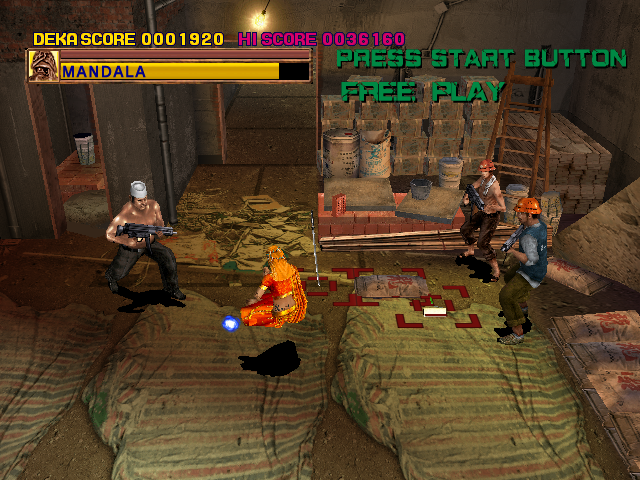
Asian Dynamite (Arcade)


 This is the third (or fourth if you count the greatly expanded PS2 port of the original) game in the Dynamite Deka series. Like so many SEGA arcade games from the 00s, it still doesn't have a home port, but it does run on the easily-emulated Naomi board. Though I do remember the early days of Naomi emulation, that this was one of the games I most wanted to play on that system, and it was so glitchy as to be unplayable. But that was a long time ago, and things have changed.


So, in keeping with the series' main gimmick, it's a 3D beat em up where almost every item is a weapon or a healing item. Some are even both, as you can pick up plates of food, pressing punch to throw some food or kick to take a bite. The plot and structure seem to be a strange mish=mash of elements from the previous games: like the first game, you're storming a building that's occupied by terrorists who've kidnapped an important person's daughter. Like the second game, you choose one of three routes of increasing difficulty at the start of the game, plus there are setpieces in this game that are clearly reskins of setpieces from the second game. For example, the small kitchen where you fought a big fat chef in that game is a small room where you fight a big fat panda in this one (well, a guy in a very realistic panda costume, at least).


It also keeps and expands upon the costume mechanic from the first game's PS2 remake. There are three plyable characters, and while playing the game, there are three diffrent coloured briefcases that cane appear as items dropped by enemies. The costumes aren't just cosmetic, but they're entire transformations with their own movesets, and most of them also have their own unique ways of interacting with the many weapons littered around the stages. Surprisingly, none of the costumes are references to classic SEGA games. Also, a useful piece of information is that all of Jennifer's costumes are both useless for fighting with and boring to control. But, you should give her a try at least once just because they're also the strangest, being a levitating yoga practitioner, a creepy jester, and (letting the weird trio down a little) a blatant clone of Marvel Comics' character Elektra.


Another returning element that's been expanded upon is the scene transition QTEs. They're annoying like all QTEs are, but unlike a lot of worse implementations of the concept, they serve to create a branching path system (like they did in the previous games), rather than being a "press the right button or die" situation. They're expanded on here by sometimes taking the form of little multiple choice questions that you only have seconds to answer, and some of them are even trick questions, like the old "What colour is the word RED in this sentence?", with the word RED actually being blue. I guess it's a way of preventing players from just memorising every QTE and forcing a reaction even from well-versed players. I don't like it, but I do approve of the ingenuity in concept, at least.


Asian Dynamite is a pretty good game. If you like the arlier games in the series, this is mostly just more of those. In some cases, it's just bits of those with a new coat of paint (and a hilariously garish gold suit on the main villain). But the new coat of paint, being a big shiny multipurpose Hong Kong skyscraper is nice, and it's a fun and weird game to play. I recommend giving it a try, while we all continue to wait and hope that SEGA starts porting Naomi and Atomiswave games to consoles someday.

Friday, 21 July 2023

Kaze Kiri Ninja Action (PC Engine)


 I wasn't sure of whether or not this game counted as obscure, but I think, in 2023, it does. It's a game that's been through a few phases, as far as its perception goes:I remember in the early 00s, when I was first dipping my toes into emulation and playing PC Engine games for the first time, Kaze Kiri was a game people were always quick to recommend. A few years later, the tide had turned a little bit, and people started saying it was a bit boring, repetitive, and overrated. Than a few more years and it was barely ever mentioned at all.


Until recently, I hadn't played it since that first era, when everyone loved it. I'd thought it was pretty good, too, but like I said, those were the days when I was first dipping my toes into emulation. I was playing lots of games for the first time, and for some reason, it wasn't one of the ones that really stuck with me. From my recent playtime with it, I can only assume I wasn't ready for it yet. It's a single plane beat em up, a genre that a lot of people misunderstand as being the over-simple vestigial ancestor to the belt scrolling beat em up. But it's also a genre for which I've grown a huge amount of appreciation in recent years. There's a lot that can be done in the genre, and even today, there's games pushing it forward, like Ninja Saviors (which is a remake, but with enough new stuff that it still be considered an advancement).


Kaze Kiri came out in 1994. The PC Engine was already an elderly console, an 8-bit that was still somehow trundling on as the age of the 32-bits was just starting to dawn. But as well as impressive ports from other systems, like Asuka 120% Burning Festival, it was still getting original games with enough new ideas and enough raw talent in their production that it sometimes didn't look like the old grandpa that it was. Kaze Kiri is one such game. The first thing that hits you about it is of course the presentation, in particular, the intro that's made up of incredible-looking full screen pixel animation. The game itself looks amazing, too with animated backgrounds and detailed sprites. Sometimes, you get something that combines the two, like an especially great-looking bossfight against a big clockwork robot in a candlelit room, the flickering light reflecting off its metal armour.


The game itself is more advanced than you might expect, too. A year prior, Shinobi III, another hardware-pushing ninja action game had appeared on a more powerful console, the Mega Drive. Shinobi III had a complex-but-intuitive control scheme that allowed a whole bunch of different commands to be mapped to only the d-pad and three buttons. I can only wonder if that was an influence on Kaze Kiri, which performs a similar feat with a d-pad and only two buttons. You can walk, run, and jump, as you'd expect. You can also throw kunai and swing your sword. Plus, you can run, perform a dive kick, a slide kick across the ground, and do quick flips backwards and forwards. None of this is complicated, and you'll figure it all out within a few seconds of starting the game. Then you get on with what the game is: fighting lots of enemies until you've killed enough to fight the stage's boss. It's a simple formula, executed with mountains of style and panache.


There's a couple more steps towards modernity, too! Your ability to throw kunai is limited not by a specific supply of the throwing blades, but instead by the fact that doing so depletes your health a tiny amount. On its own, that would be annoying. Maybe even unfair. But couple with the very twenty-first century design decision of having your health constantly (but very slowly) regenerating, it makes total sense as yet another way of streamlining all the game's many systems, making a faster and simpler game while still putting a relatively huge amount of tools and possibilities into the player's hands. Just like the control scheme!


After reading all that, it won't surprise you to hear that I recommend Kaze Kiri. To everyone! Go and play it! It's the kind of incredible, high-quality game that can really make you excited about videogames and their design. Don't give a penny to the scamming bastards on ebay, but play this game at your earliest convenience. It's an essential play for anyone who appreciates action games, and it should re-rise to its formerly-held position of prominence in the PC Engine library.