Friday, 9 December 2022

Fox Junction (Playstation)


 This game has been a fascination for me for probably about a decade at this point! There's just something about the way it looks and sounds that's really caught my eye, and as the years have gone on, I think I've figured out most of the mechanics despite the language barrier. There's still a big wall impeding my progress though, that I don't think I'll be able to surpass until it gets a translation patch, but I'll tell you all what I (and people in a few forum threads over the years) have been able to ascertain.


First, it's a real time 3D semi-roguelike, where you go to various maps. In the maps, there are, as you'd expect, enemies, items, and traps. There's also a teleporter in each map. This is because all those maps are just squares on a bigger map, that looks like a multicoloured patchwork quilt, each coloured square representing a map and its theme (desert, cave, night town, plains, and so on). There's a tower visible in the distance, and its location is constant: if you see it in the north in one map, then take the teleporter north from there, it'll be closer in the next map, for example. And that's where I've hit the wall! I have no idea what you're meant to do once you get to the tower.


However, there's still lots of information I have to give you. So, some of the items are stuff you'd expect, for healing your HP and replenishing your ammo. Some of them are "Drums", which are like files in the game's world. And some of those drums, the ones with P in their name, tell you how to build robot companions called Palmata (I assume a portmanteau of Pal and Automata). The enemies sometimes drop robot parts bearing their names, and these P drums tell you which of these parts you can combine to make your palmata. Give them a weapon too, and that's a new friend you've made!


Now, to attack, you hold R1 and press square, but if you have a palmata equipped, holding R1 brings them into the fray to fight in your place. This is essential, not only because it means they take all the hits instead of you, but also because, as far as I can tell, your weapon never gets more powerful. So to fight tougher enemies, you've got to find the parts to create stronger palmata and the compatible weapons to give them!


Regarding the language barrier, like I said: I've hit a wall in my progress through the game. But, I've still managed to enjoy hours of it, just through exploring the worlds, trying to get a little further, and so on. It was incredibly satisfying building a palmata for the first time, once I figured out the game actually tells you what parts to combine, and you don't need to use trial and error like I had been doing! I think it's probably going to be a lot more difficult if you can't at least read katakana, though. Enemy names (which correspond to the palmata parts they drop), along with a lot of other items are named in katakana, and being able to identify them at a glance is obviously a lot easier than memorising symbols that have no meaing to you.


There's apparently a fan translation in progress, by the people who recently translated Iblard Laputa no Kaeru Machi. I'm very much looking forward to it, but in case anyone wants to give the game a try before it comes out, I hope the information here is at least a little useful. (Also, I wish I'd bought a real copy of this game back when I first found out about it, as the price has shot up to ludicrous levels in the years since!)

Friday, 2 December 2022

SEGA Ages 2500 Series Vol. 5: Golden Axe (PS2)


 I remember first seeing the boxart for this game on Lik-Sang or some other import site not long after it came out, and being amazed that there was a new Gold Axe game, and frustrated that not only was no-one talking about it, but there were no signs of it ever getting released in Europe. It did get that Europe release a few years later though, as part of the SEGA Classics Collection that compiled a bunch of the SEGA Ages 2500 Series games onto a single disc. Everybody hated it!


I tolerated it at the time, partly from nostalgia, and partly from the  beat em up drought that had been ongoing for about a decade at that point. Playing it again now, a decade and a half later (meaning it's now older than the original Golden Axe was when it was first released!), my opinion's a little more reasonable, and though it's not the irredeemible garbage people made it out to be when the Classics Collection came out, it's not particularly great, either.


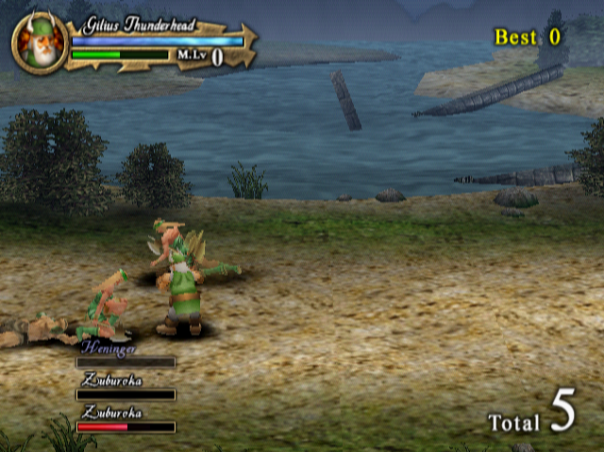
It looks okay for a nineteen year old budget game, though there are some massive weak points, like how most of the magic attacks other than Tyris' dragon summon look pathetic, and how Gilius looks like a bendy rubber action figure that's been played with too much, giving him weird bow legs and arms constantly stretched outwards. The few cutscenes look pretty nice, though, thanks to the developers went the route of using low polygon count models and covering that up with higher resolution textures. So the characters actually look better in close up than they do while you're actully playing the game.


As for how the game plays, it's a mixed bag that's mostly bad. There's some stuff I do like, such as the magic potion system being replaced by a meter that fills up as you attack enemies, so you get to use your magic more often. The little elves (who now look like little kobold creatures) are still present, with the potions giving a large amount of meter in one go. A nice little touch is that if you make them drop a potion, then leave it on the ground for a while, they'll pick it back up!


As for the bad, there's quite a few things. Gilius is so slow as to be pretty much useless to play as. The same can also be said of the back attack that every character has, though the normal attacks have such weird hitboxes that you'll usually hit enemes that are behind you if they're stood closely enough anyway. There's very few enemy types, and a lot of stages don't even have bosses at the end of them! An upside of the scant variety in enemies is that you can learn their behaviours pretty easily, I guess? The main thing to remember is that every enemy, if they're at the other end of the screen from you, will do a running attack. So try not to be stuck mid-combo when that happens.


There's really no reason to play this version of Golden Axe in this day and age. The arcade original is better, and the Mega Drive port of that is pretty good too, making up for its slightly worse graphics with a couple of extra stages. Hopefully SEGA will let someone give Golden Axe the Streets of Rage 4 treatment, and we'll get an all-new, excellent game that also looks amazing. Or at the very least, I hope Revenge of Death Adder gets a home port someday. One final thing I'll say about SEGA Ages Golden Axe, though: it's a lot better than the absolute garbage that was Golden Axe: Beast Rider.