Showing posts with label dreamcast. Show all posts

Friday, 7 August 2026

Spirit of Speed 1937 (Dreamcast)


 If you've heard of this game, it's probably due to its presence on various "worst Dreamcast games ever" lists. However, it doesn't look too bad in screenshots, and it's a Dreamcast racing game, so I assumed it couldn't be as bad as people say. Plus, the old timey setting was a pretty appealling gimmick, so I gave it a try. And at first, it seemed like everyone was being too harsh on Spirit of Speed: it's a little clunky, but initial impressions are of a mediocre racing game that might provide a little bit of fun, if you're into the setting.


Then, you notice how long the races are. Either the track you're on is incredibly long, with lap times of multiple minutes, or you're expected to drive around the track ten or twenty times. Either way, most races are projected to take over ten minutes, sometimes significantly longer than that. On top of that, despite the game's title, you never fel like you're going fast, even at top speed in the game's fastest car. So every race has you slowly trundling around a track for a long, long time. At least the cars and tracks themselves do look pretty nice. 


Despite the ludicrous length of the races, I did want to finish at least one of them, in the interests of fairness. I'm not sure if it's actually possible to place first in the races, because while you're always limitd by the tchnical limitations of these old timey cars: slow accelleration, inability to take corners at any kind of speed, and so on, it seems like there's always one opponent who faces no such limitations, able to just shoot off at the start of the race, never to be seen again. The rest of them are just like you, though, so once you've left them behind, you'll likely spend a lot of time in second place, all alone with most of your opponents getting left further and further behind you, and one opponent getting further and further ahead of you.


However, I was never able to finish a race, as every time, without fail, something would happen to prevent me from doing so. Sometimes, the game would suddenly crash. Sometimes, the car would inexplicably stop accellerating for no obvious reason, meaning the race had to be quit via the pause menu (because this wasn't some kind of deliberate game condition that makes you instantly retre from the race). One time, I paused the game, and it just wouldn't unpause no matter what. So as well as being poorly designed, it seems that Spirit of Speed 1937 is also incompetent on a technical level.


I approached this game with an open mind. I think I've been clear in the past on the subject of how little patience I have for received opinion, especially when it comes to games that are supposedly universally reviled like Spirit of Speed is. However, in this instance, I have to admit that the mob is right: this is a game that fails at everything it tries to do, on almost every level. The only positive thing I can say about it is to repeat that it does look pretty nice in screenshots. It's just unfortunate that to take those screenshots, someone has to actually (attempt to) play it.

Friday, 27 February 2026

Moero! Justice Gakuen (Dreamcast)


I know this game isn't particularly obscure, but this is a special case. This is specifically the Japanese version of the game also known as Project Justice, and a big difference between the two versions is that Moero! Justice Gakuen had a whole mode that was removed from Project Justice. That mode is Nekketsu Nikki (Hot-Blooded Diary), a character creation mode, combined with a board game with a tiny bit of dating simulation in there for flavour. A translation patch for it recently got released, and since, along with the life sim modes that were cut out of its Playstation forebears, this has been one of my most-wanted translations for as long as I've known that fan translations existed, I thought it worthy of a review.


With that in mind, I won't be speaking much on the actual fighting game here. Most of you have played it, and know that it's excellent already. It was a big obsession for me as a teenager, and because I couldn't find any copies in the shops in my town, I'm pretty sure it was the first game I ever ordered online (at a friend's house after school, as I had neither a PC nor my own bank account at that time). Instead, let's first talk about how character creation works. You name your character, choose their gender and their school, as well as their haircut, eyes, nose, and mouth. It's slightly disappointing that there's no customisation at all beyond that: it would have been cool to be able to make a character who's made a few minor changes to their uniform, or even to give them a different body type or hair colour than the default. But never mind, I think it's still possible to make characters into whom you can breathe a little life. (I have to admit that it was pretty clever of Capcom to use the conceit of all the characters being uniformed students to make a character creation mode possible, while justifying not having to model hundreds of different clothing items.)


You also choose their best school subject and three words from a selection. These choices affect your character's starting stats, and if you're boring, you can look at gamefaqs to find ancient guides written around the time of the game's release to find out the most optimal choices here. But, keeping with the spirit of the game, you should really think of the character you're making, and choose based on the personality they have in your imagination. What you notably don't get the freedom to choose are any of your character's special moves, or even their fighting stance and normal attacks. They'll be decided during the board game, which is themed around a school festival. 


The board game takes place over forty turns (it goes by quicker than it sounds like it would, as long as you only giver yourself one CPU opponent), and takes place on a big path of squares, laid out like a school festival. Most of the squares will slightly increase one of your stats when you land on it, some represent class credits (which I'll explain later), others give you cards, some are there to dish out special moves, and there's a rare few that reduce your stats. You spin a spinner each turn to see how far you move, though you can choose which direction you move in. Also, there are actual characters from the game wandering around, and if you land on the same space as one, you get to have a little interaction. Keep doing this with the same character, and you can befriend or even romance them (The whole series, in these console-exclusive modes, assumes that everyone is bisexual. Which is nice.). Though, chasing them arond the board would get in the way of trying to win the game or make your character stronger, so it's something to which you'd have to really dedicate a run and a junk character. An interesting thing about the special moves: though most of them are the moves of characters in the game, there's also a few moves that are only in this mode, plus the entire moveset of Street Fighter's Sakura Kasugano (who was a guest character in the first Rival Schools, but not this one). 


Regarding the class credits, those are the way you win the game, and if you do a good enough job, they'll be a big contributor towards your character's stats and their access to burning vigor moves. You get a randomly generated bingo card at the start of the game, with the spaces being these class credits. So, you've got to go around the board landing on them to fill your card. Getting a full row either increases all of your stats by one level, or gives your character a BV move. Furthermore, you get points for getting them, and at all times, one of them is a special space that gives an extra fifty points for landing on it (at which time another class credit space becomes the special one). After the fortieth turn, there's a CPU-controlled fighting tournament for all of the characters that were in the board game, which dishes out more points depending on where characters placed. And after that's done, the character with the most points is declared the winner, and gets to choose either another BV move (or their first if they didn't get any before this point), or a boost to all of their stats.


Then, you can save the character and play as them in all the actual fighting modes the game has! It's really a massive shame Capcom couldn't be bothered to translate this mode back at the time of the game's release, because I know as much as I played the English version as it was, with this mode, it would have gotten hundreds of hours of play. I know my friends at the time would have enjoyed creating characters and playing the board game, maybe even going so far as to each have our own custom trios to fight against each other in versus mode! We missed out on so much back then, didn't we? That's before you even get into the massive amounts of lore for this series that was printed in Gamest Mooks and never translated. But now we do have this mode, and it's excellent. And a (very) little bit of the extra lore got translated in the artbook Udon put out last year. Obviously, I very highly recommend playing it, and I hope that the existence of this translation is a good omen that we'll get the lifesim mode from at least one of the Playstation games translated in the near future. 

Friday, 9 January 2026

Time Stalkers (Dreamcast)


 Time Stalkers (also known as Climax Landers) has been on my radar for a long time, mostly by virtue of it being a Dreamcast RPG that's available in English that isn't one of the more popular few, like Skies of Arcadia or Grandia 2. There aren't many of those around (but it seems like there are people working on translating SEGAGAGA and El Dorado Gate, which is exciting)! Another point of interest is that it's a crossover game, featuring characters from a bunch of Climax's earlier games, like Landstalker and Shining in the Darkness. 


Oddly, this wasn't used as a selling point when it was originally released (at least, it wasn't in English-speaking places. Maybe it was in Japan?), and as hard as I've tried to find one, it seems that no-one (again, in the English-speaking world) has cared enough to list all of the characters and the games they're originally from. And unfortunately, I'll have to pass that disappointment forward: I probably could, with an hour or two of research, be able to place all the characters and their source games together, Time Stalkers just isn't a good enough game to be worth that much effort.


The plot is pretty generic crossover stuff, withfragments of different worlds all being drawn into some new pocket dimension by a mysterious force. An old man designates someone from each realm as a hero, giving them the ability to enter dungeons. The dungeons are procedurally generated, and you have a hunger meter that goes down as you explore them, like in a roguelike. But the combat is pretty generic turn-based RPG combat, but slower. It's so slow and so pointless and such a big part of the game. You'll dread missing an attack (which happens a lot in this game) not becuse you're scared of the enemy getting another chance to kill you (they mostly only deal a single point of damage), but because it means the battle will drag on for another slow, labourious turn.


There's other roguelike stuff in here, too, like how you return to level one every time you enter a dungeon. Which wouldn't be a problem in an actual roguelike, because they're all about learning how each enemy works, how to position yourself, how to use items effectively and so on. But Time Stalkers is all about getting through so many identical fights where you and the enemies slowly trade hits back and forth until somebody's dead. you could theoretically just run past the enemies and avoid entering battle, but every dungeon ends with a boss who's significantly more of a threat than the entire rest of the dungeon's enemies put together, and if you don't grind, you'll stand no chance against them. You do, at least, get to keep your equipment between runs, so you're not completely back to nothing every time, I guess.


There's also a mechanic whereby you can capture enemies and use them as party members, but since they're all so weak, it seems kind of pointless, unless you want to partake in even more grinding. The one kind thing I can think of to say about this game is that it looks kind of charming in that specific "low-poly models with high resolution textures" way a lot of low budget third party Dreamcast games are. Sometimes it's actually really ugly, but there's also plenty of times where the camera's at just the right angle to make it look kind of cool. Still, it's not enough to make suffering through the game worth your while. I hated Time Stalkers more with every additional minute I spent with it (I played for about four or five hours, up until the end of the third dungeon. Some of that time was spent running circles around the tiny overworld, desperately trying to find the next person I had to talk to to advance the story), and it definitely doesn't carry my recommendation.
Friday, 26 September 2025

Karous (Dreamcast)


 You might notice that the screenshots on this review are a combination of arcade and Dreamcast shots. This is due to my own technological ineptitude, and it doesn't really matter, since I mostly played the Dreamcast version and that's what I'm writing about, and also they're identical anyway, the only difference being that the Dreamcast version has a fanmade English translation. 


Karous is from Milestone, a developer mostly known for shooting games, especially their late-release Dreamcast duology, Radirgy and this one. It came out a year after Radirgy, and the first two things you'll notice about it are how much it doesn't look like its forebear (Radirgy had a very colourful Akihabara-inspired look, while Karous goes for a moodier tone, with muted colours and lots of grey), and how much it appears to play like its forebear. 


Like Radirgy, Karous arms you with a gun, a sword, and a shield. The gun and sword are each assigned to a button, and the shield appears in front of you when you aren't using either of the other two. You also, like in Radirgy, have a forcefield that projects outtwards to protect you and continually damage any enemies it touches, and it can be used whenever a meter that incrementally fill every time you damage an enemy or cancel an enemy bullet completely fills up. You can even hit power ups and points items with your sword to change them into different things!


What's different, though, is the scoring system, which offers a stark contrast to that seen in the earlier game, which had you constantly trying to fill meters as quickly as possible and collect items and so on, and never taking a break. In Karous, the scoring system and the power-up system are linked. Whenever you use one of your three main weapons, they gain experience, and gradually level up (don't worry, it's still a completely linear STG, so there's no grinding and the levelling is more like Radiant Silvergun than an RPG), increasing their power very slightly every time. You also have a constant multiplyer that's made up of all three weapon levels combined. So again, like Radiant Silvergun: playing for survival and playing for score are one and the same. You want you weapons to be more powerful, and making them so is also how you score more points.


Though I was initially put off by the miserable look of the game, and the fact that the 3DS sequel/spin-off Karous: The Beast of Re:Eden was awful, but Karous is a game I just keep going back to! The basic Milestone mechanics are enjoyable as they are, and the ways in which it's less stressful than Radirgy have their own appeal, too. You should definitely give it a try!

Saturday, 25 February 2023

Fushigi no Dungeon Furai no Shiren Gaiden - Onna Kenshi Asuka Kenzan! (Dreamcast)


 Or if you'd prefer, Mystery Dungeon Shiren the Wanderer Sidestory - The Swordswoman Asuka Appears! So obviously, it's a spinoff from the Shiren the Wanderer series, which in my opinion are the absolute height of the roguelike genre, with very little else even coming close (in fact, the only rival the series has in my mind is One Way Heroics, and that must be a friendly rivalry, since Shiren characters have appeared in that series too).


This one just recently got fantranslated, and only partially: so far, the first "area" is translated apparently. I don't know exactly what that entails, but I've finished the first dungeon, and made a decent way into the second and everything's still in English. The story concerns Asuka, the eponymous swordswoman and a friends of the series' protagonist Shiren. She finds herself in a valley where the local ninja clan, who once protected the people from monsters, have begun robbing people and poisoning the river, and Asuka steps in to investigate. Of course, the ninjas aren't acting of their own volition, but I won't spoil anymore of the plot for you.


This mostly plays pretty much exactly like one of the regular Shiren games, with a few elements I haven't seen in the others. But even that's standard for the series, since they all seem to have a few unique elements to them. This time around, there's the Monboxes, which are items that can be used to summon monsters to act as sidekicks if you don't have any actual sidekicks. I haven't found much use for them, to be honest. There's also a new scroll/wand effect: being able to set fires that burn over a large area for quite some time, doing damage every turn to anything that's caught in them.


I wasn't keen on the graphics at first, as they eschew the series' usual high-quality pixel art in favour of pre-rendered sprites and backgrounds. The game's look quickly grew on me, though, as everything's detailed and sharp enough that it doesn't have the usual ugly blobby look associated with pre-rendered graphics. Coupled with the background music, there's a lot of atmosphere to be felt and enjoyed in this game's dungeons, too.


I don't really have a lot more to say about this game. If you like the Shiren games, this is essentially another one of them, and if you're not familiar with the series, I recommend going and playing the first game, either in its original SNES form, or its later DS port, which even got an official English release! (I'm not sure if this game even counts as being obscure, but it's been the majority of my game-playing this past week, alongside Shenmue 3. So sorry if it doesn't meet your obscurity standards!)

Friday, 20 January 2023

Doki Doki Idol Star Seeker Remix (Dreamcast)


 This is a bold statement to make, but Doki Doki Idol Starseeker Remix does for Minesweeper what Logic Pro did for Nonograms: takes the basic concept and turns it into an actual exciting videogame, rather than a leisurely time-passing puzzle. It's really a shame that the Dreamcast is the only home port it ever got, as it's simple enough and has enough appeal that it could really have had decent ports to pretty much every mainstream system of the twenty-first century, from the Game Boy Advance to the PS5.


How it works is that it's a lot like minesweeper played on a grid of hexagons instead of squares, and your cursor highlights seven (the one it's on, plus the six touching it) of them. You'll be given a number, which shows how many stars (this game's mines) are in those seven hexes. If there's zero, you can instantly clear out the seven by pressing A. By moving around, you figure out where the stars are and press B to put a flag on them. Then, if you put the centre of your cursor over a flag and press A, assuming all the flags actually are correctly placed over stars, the stars will be cleared, you'll get a bunch of points and some extra time, and if there's no stars left to find, you'll clear the stage and go onto the next one.


The more stars you clear in one go, the more points and extra time you'll get for them. So you'll get the most points if you clear all the stars on a stage in one big sweep. But, as the stages go on, the timer can get really short, and you might have to clear the stars you've got before then just to claw back the few seconds you need to find the rest. It's a cool mechanic that build tension and really encourages the "score vs survival" feeling that's present in a lot of great shooting games.


This is an arcade port, and it has a few extra features. Star Seeker mode is closely based on the arcade game, and just has you going through sets of stages of gradually increasing difficulty, trying to score points. Doki Doki Idol mode is a console-exclusive story mode, with a few chapters, which tell the story of a manager bringing together some girls to form an idol group, and then the blossoming friendships between these characters. That's what it looks like it's about based on the pictures at least. There are also art gallery and sound test modes, but they have to be unlocked, and though I've been playing quite a bit of this game over the past week, I'm not yet good enough at it to have done that yet.


This is an excellent game, and I strongly recommend that you find a way to play it. Despite what I said in my Charge'N Blast review, and this being a late Dreamcast release with presumably a smaller-than-usual print run, the prices for it vary wildly from reasonable to absurd. But even if you can't find a reasonably priced copy, I'm sure you can find some way to play it. And again: you definitely should, it's great.

Saturday, 31 December 2022

Charge'N Blast (Dreamcast)


 There was a big problem in the world of UK-based Dreamcast magazines. Though the console was mostly a home arcade machine, made by an arcade company, and with many arcade ports in its library, both first and third party, most of these magazines seemed to be staffed by writers with a bizarre pathological hatred for arcade games. Charge N Blast was a game they really, really hated, of course.


The big point of contention with a lot of the critics at the time was its length. And yes, if you don't care about actually playing the game, and you just want to credit feed your way to seeing the end credits, it is a very short game. Probably less than half an hour. But I don't know why you would do that. It's not an enjoyable way of playing any kind of game. I find it boring to use continues, as I'm sure I've mentioned numerous times before, and after a couple of hours of playing Charge N Blast, I can semi-reliably get about half way through the game on a single credit.


Addressing the follies of generations past aside, how does the game actually play? Pretty well, and, more interestingly: pretty idiosyncratically! It looks like a standard Cabal-alike, which was a long-dead genre in 2000, but it's actually something a little more unique. The best way to describe it would be to describe the control system, which does take a little getting used to at first. You use the d-pad or analogue stick to move your crosshairs around and aim at enemies, and the shoulder buttons to move left and right to dodge enemy attacks. 


That's odd enough, but it's shooting where things get even more unusual. Each character (there are three to choose from) has three weapons, and each is assigned to the X, Y, and B buttons. These aren't fire buttons, though, but they start charging the weapon up; the longer you leave it before firing, the more powerful the shot will be. Furthermore, some weapons let you lock onto multiple enemies by moving the crosshair over them while the weapon charges. Then, you press A to actually shoot. So, rather than switching between your three weapons, you instead choose which one you want to charge a few seconds before you actually make each shot.


It's a fun and interesting take on the old crosshair shooter, and though it could have been done a few years earlier with sprite scaling, the turn-of-the-century polygons look is fine, too. Like I said, it takes a bit of getting used to, but once you do, it's a fun and unique game, and I recommend giving it a try. Unfortunately, it seems that the Dreamcast has gone the way of the PC Engine in terms of ludicrous game prices, though, so emulate it, unless you're rich uncle moneybags.

Friday, 9 September 2022

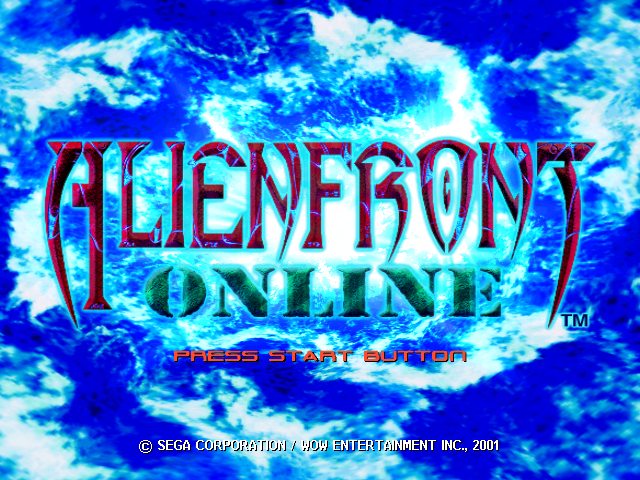
Alien Front Online (Dreamcast)


 This is a game from the latter days of the Dreamcast's official support that I always wanted a copy of after seeing it in magazines,  but it was slightly before the time when I was able to import games and it only got released in North America. It's probably for the best, though, since many of my Dreamcast play at that time was multiplayer, with four people crowded into my room, and as the name suggests, this one was online only.


Anyway, it's a game about groups of tanks waging battle against each other, one side humans, the other aliens. The single player arcade mode is actually a lot like a game I wrote about not long ago, Polygonet Commanders: you fight against the opposing force, and there's a strict time limit. Killing three enemies gets you ten extra seconds (and it really does mean you have to do it, any enemies killed by your AI comrades don't count towards this), and winning a battle (by killing fifteen of their tanks before they do the same to you. AI contributions do count towards this, at least) gets you a whole bunch of extra time depending on your performance. Usually about forty seconds in my experience. I haven't actually lost a battle in arcade mode yet, though I always get a game over via timeout three or four stages in, which is a little frustrating.


There's also a "tactics" mode which is an attempt at a longer single player campaign. It's not very fun to play, though, with missions like "drive over all the stationary targets within the time limit" and "shoot all the stationary targets within the time limit". It does eventually go on to give you proper battles, but there's no reason to pick this over arcade mode, to be honest.


Actually playing the game feels pretty good. Each side has three vehicles, filling the roles of light, heavy, and medium, of course. The human vehicles are all tanks, and all basically feel the same to control, other than their movement and firing speed. The alien vehicles are much more interesting, being made up of a hover tank and two- and four- legged walkers that all feel very different from each other. The controls are pretty old fashioned, using the analogue stick to both steer and move forward and backwards (there's no vertical aiming), and you can use the shoulder buttons to strafe, too.


Though I obviously haven't been able to play this online, thanks to the existence of ancient textfiles online, I have been able to find out somethings that are mildly interesting about the experience. Firstly, though the game doesn't support the Dreamcast Broadband adaptor, it apparently does support voice chat over its dial-up connection, and was even packaged with a mic! This might have been a contributing factor in a common complaint across the accounts I've read though: difficulty connecting to matches, and even worse, difficulty staying connected to matches. Most amusingly of all, though, is that there were a couple of secret match types that were accessed by inputting cheat codes as the name of your online lobby. However, lobbies couldn't share the same name, so only one group of players could use these cheats at a time!


Though obviously it can no longer be played as originally intended (as far as I know?), I think Alien Front Online is still worth a look. Even single player, it'll provide you with an hour or two of decent tank fun before you get bored of it. That assuming you're emulating, of course. The prices legitimate copies fetch online are not a good investment.

Saturday, 28 August 2021

Rainbow Cotton (Dreamcast)


 This is a game I somehow only recently got around to, despite having been meaning to play it for almost twenty years! Back in the Dreamcast's original heyday, it was one of the Japan-only titles I really wanted to try out. Then when Dreamcast emulation first came about years later, this game was just a little too much for my computer at the time to handle. A few more years (and a couple of dead laptops) later still, and an English translation patch, that even subtitles the FMV cutscenes gets released, and I finally got around to playing it.


The game is, of course, part of the long-running Cotton series of shooting games, and more specifically it's a sequel to the Mega Drive game Panorama Cotton, both games being Space Harrier clones, rather than the horizontally scrolling 2D shooting games more typical of the series. The first thing that'll hit you about the game once you start playing is how nice it looks. It's definitely among the best-looking games in the whole Dreamcast library! There's an incredible use of colour, and everything looks like an amazing fairytale dreamworld, almost as if they'd made a shooting spin-off from NiGHTs into Dreams. If I had played the game around the time of its release in early 2000, I don't think I would have ever seen anything like it before!


Unfortunately, the game itself doesn't live up to the visuals. It's just got lots of tiny little faults that all add up. Cotton herself gets in the way of where you're aiming and blocks your view of incoming enemy shots, too. You have a health bar instead of lives, and I don't think there's enough feedback when you get it, either. So if you don't pay attention to your health bar, you'll suddenly die without even realising you'd taken a lot of hits. None of these things is game-breaking on its own, and even added up, they don't make the game a bad one, but they are annoying, and it feels so close to being an actual good game, rather than one that's merely okay.


I think I can recommend this game conditionally. If, like me, you've been curious about it for a long time, then now is a good time to seek it out. Though the plot, as revealed by the subtitled cutscenes isn't really anything particualrly special, the whole experience of the excellent graphics and those turn-of-the-century animated FMVs does feel like something I would have loved back then, so there's a kind of retroactive enjoyment there. You should probably just emulate it, though, since the prices legitimate copies fetch these days are, just like its Mega Drive forebear, ludicrous.

Friday, 14 February 2020

The Lost Golem (Dreamcast)

Remember Pushover on the Amiga? It was a puzzle game about an ant pushing over dominos. The Lost Golem reminds me of that game, only it's top-down, rather than side-on. You play as a golem, who iis charged with looking after a king. The king, like most royals, is some kind of blinkered lemming-esque idiot who constantly walks foward until he hits an obstacle, at which point he turns ninety degrees and carries on. Unless the obstalcle is a bottomless pit, then he walks into it and falls to his doom.

So, what you have to do is go ahead of the king, pushing walls around using you immense golemic strength, to make sure that the king's walk takes him to the next door. There are, of course, some further complications. The first is that the king has to walk directly towards the door, as if he approaches it from the side, he'll go straight past it (he's a blinkered idiot, remember?). The second, for which I have no explanation, is that a certain number of the walls in the stage have to be connected by pillars when the kind goes through the door. Pillars will crumble away when there's no walls touching them, and there are two kinds of pillar (in the stages I could reach, anyway): ones that cause attached walls to rotate ninety degrees when pushed, and ones that just let their attached walls go forward one space when pushed.

So, like most puzzle games of this type, those are the elements that make up the stages, and the rules that make up the puzzles, and the game itself is just a long series of those puzzles. Also like most puzzle games of this type, I'm terrible at it. Unfortunately, the stages in the main mode have to tackled in a linear fashion, and I managed to get to the thirteenth of them, which I made many attempts at before giving up. But, as far as I can tell, this is a decent enough example of these kinds of games. There's some stages where you try every convoluted solution you can think of before it hits you that you literally only need to make one move to solve it. That seems like a good thing to me.

There's a couple of other diversions besides the main story, too! There's a simple stage editor that lets you set up a stage in a 3x3 grid, and I guess if you've got the patience for this kind of game, you probably also have the patience to make stages for it, too. I know for a short time back in the ancient past, I was playing a lot of Chu Chu Rocket, and enjoyed that game's stage editor, and it's the same principle, isn't it? Finally, there's a two player versus mode, with a king, two golems, and two doors. You move walls around to annoy your opponent and also guide the king to your door. There's no AI opponent, though, and even if you had someone around, I can't imagine wanting to play this over any of the Dreamcast's many excellent fighting games.

The Lost Golem is of a genre that's a little outside of my wheelhouse, but I think I enjoyed it enough to say that if you like puzzle games where you move stuff around and there's a specific solution to every stage, then this is a decent one of those.